

The Birth of Venus Explained: The Myth, Figures, and Symbols
Identify the figures, shell, roses, pose, and myth in Botticelli’s Birth of Venus. Learn why the scene shows her arrival rather than the moment of birth.
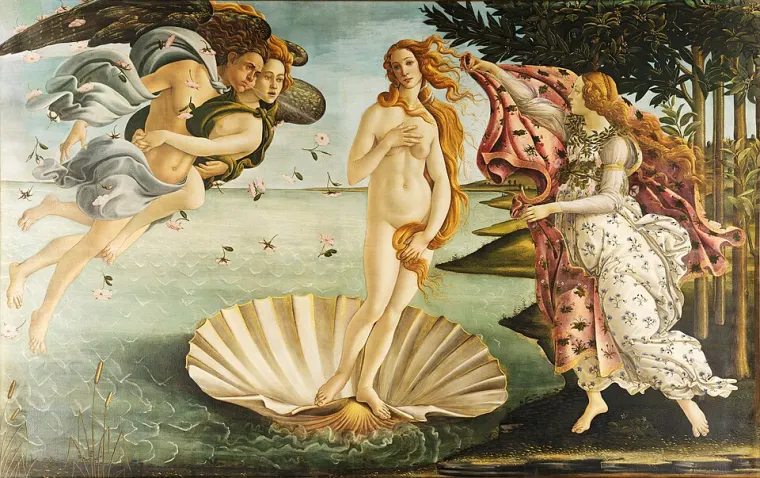
Despite its familiar title, The Birth of Venus does not show the goddess emerging from sea foam. Venus already stands fully formed on a shell, carried to the Cypriot shore by wind and about to receive a cloak. Reading from left to right reveals a sequence of propulsion, arrival, and reception around her still central figure.
Essential facts about The Birth of Venus
| Item | Detail |
|---|---|
| Artist | Sandro Botticelli |
| Date | c. 1485 |
| Medium | Tempera on canvas |
| Dimensions | 172.5 × 278.5 cm |
| Collection | Uffizi Galleries, Florence |
| Subject | Venus arriving on the shore of Cyprus after her birth from the sea |
At roughly 1.7 by 2.8 meters, the painting is much larger than its reproduction in books suggests. Botticelli used canvas rather than a wood panel. The Uffizi notes that canvas in the fifteenth century was widely used for works decorating aristocratic residences.
The support fits a mythological image intended for a private environment rather than an altarpiece. “The Renaissance revived antiquity” is only the beginning of the explanation; the work’s location and audience matter too.
The scene is an arrival, not the instant of birth
Ancient myth describes Aphrodite—Venus in Roman tradition—being born from sea foam. On Botticelli’s canvas there is no emergence. The adult goddess stands on a shell while a figure on shore reaches out with clothing.
The Uffizi likewise describes the subject more precisely as the goddess’s landing. The conventional title is useful, but it shifts the moment represented.
Ask what is about to happen. The winds at left move Venus, the figure at right opens a cloak, and the goddess is crossing from sea into a social world on land.
Read the figures from left to right
| Position | Figure | Role |
|---|---|---|
| Left, behind | Zephyrus | The west wind blows Venus toward shore |
| Left, in front | A woman called Aura or Chloris | She embraces Zephyrus; her identity is not certain |
| Center | Venus | She stands on a giant shell in a pose derived from ancient sculpture |
| Right | A Hora of spring, or one of the Graces | She offers a flowered cloak; the exact identity is debated |
The identities at either side are less certain than Venus herself. Zephyrus is recognizable as the blowing west wind. His companion is described as Aura or Chloris in different accounts. The woman at right may be a Hora associated with spring or one of the Graces.
Uncertainty does not prevent us from reading their actions. Breath and flowers travel from left toward the center; a patterned cloak reaches from right toward Venus. Forces converge on the goddess without disturbing her frontal stillness.
What do the shell, roses, cloak, and orange trees mean?
Shell
The giant shell carries Venus across the sea and has become the painting’s most recognizable attribute. It connects birth from water with arrival but should not be treated as a naturalistic vessel.
Roses
Roses scatter through the wind. In classical and later traditions they belong to Venus and love. Their direction also makes invisible air visible.
Cloak
The flowered cloth marks the next action: the nude sea-born goddess will be covered as she enters land. It sets up a contrast between exposed body and patterned textile.
Orange grove
The right side changes from open sea to cultivated shore. Orange trees were also associated with Medici environments, but their presence alone cannot prove a particular commissioner.
Graceful outline takes priority over anatomical probability
Venus’s neck is unusually long, her shoulder falls steeply, and her weight does not settle convincingly onto the shell. Her covering gesture echoes the ancient Venus Pudica type, represented by sculptures such as the Medici Venus.
Botticelli is not failing an anatomy test. He uses the body as a continuous contour: hair, bent arm, hip, and supporting leg create a long wave. The visual rhythm answers the blowing fabrics and moving sea.
The most useful comparison with ancient sculpture is therefore not “copied pose” alone. A volumetric marble body has been translated into a linear figure whose beauty depends on the surface.
The Medici commission and Simonetta Vespucci are not established facts
The painting is often described as a Medici commission, sometimes specifically for Lorenzo di Pierfrancesco de’ Medici. Its later presence in a Medici villa and its subject make that connection plausible, but no surviving commission document settles the original patron.
Simonetta Vespucci is frequently named as Venus’s model. She had become a celebrated Florentine beauty and died in 1476, years before the usual date of the painting. No documentary evidence proves that Botticelli made the face as her portrait.
The same discipline applies to both claims: state the historical connection, then state the gap in the evidence. A compelling story is not made stronger by hiding its uncertainty.
A sequence for looking at The Birth of Venus
- Trace the wind from the puffed cheeks at left toward Venus
- Follow the falling roses and the strands of hair in the same direction
- Compare Venus’s still vertical pose with the diagonal movement around her
- Identify the point where sea gives way to cultivated shore
- Follow the cloak toward the body and imagine the next second
- Step back and see how the wide canvas holds three separate groups together
The distinction between a compelling story and surviving evidence also matters in The Kiss by Gustav Klimt. Its broad shape can suit a desktop, but preserving both wind gods and the welcoming figure requires care. Use the MacBook wallpaper resolution guide before cropping.
Collection sources
Keep a painting like this on your Mac
Art4 lets you browse public-domain paintings by artist, movement, color, and screen shape, read the story behind each one, and set it as your wallpaper, or let it rotate on its own. Try it free for 7 days; if you keep it, it’s a one-time $14. Requires macOS 14 or later, or Windows 10 or later.


