
The Kiss by Gustav Klimt Explained: Gold, Pattern, and Meaning
Examine the gold leaf, geometric patterns, flower meadow, and cliff edge in Gustav Klimt’s The Kiss. Separate visual evidence from uncertain model theories.
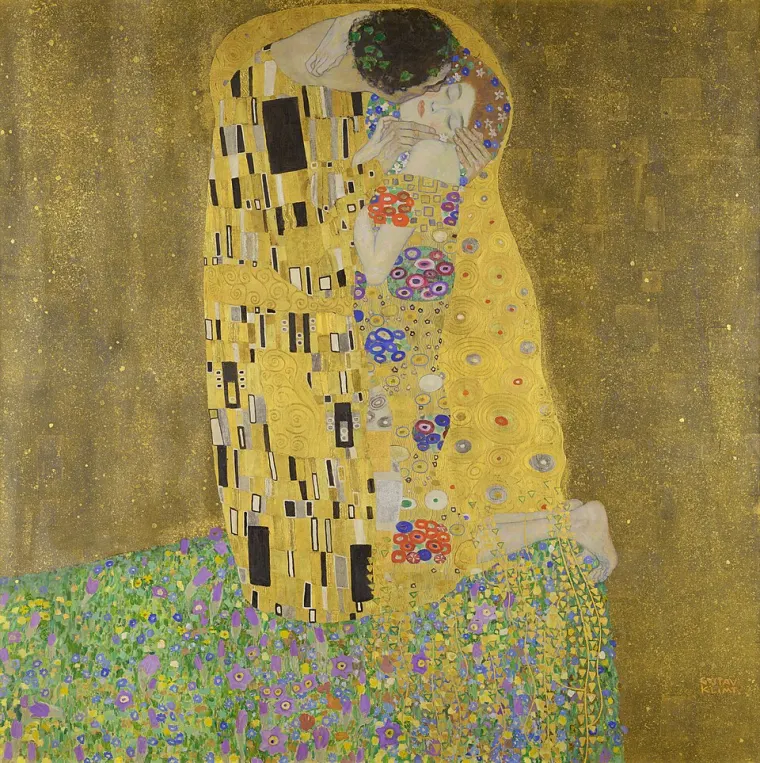
Gold does more than make The Kiss luxurious. It weakens the boundary between clothing and background, gathering two bodies into one broad shape. At the same time, their feet meet the end of a flowered ground. Intimacy and instability coexist, preventing the picture from becoming only a decorative romance.
Essential facts about The Kiss
| Item | Detail |
|---|---|
| Artist | Gustav Klimt |
| Date | Shown in 1908; completed in 1909 |
| Medium | Oil, gold leaf, gold powder, silver, platinum, and other materials on canvas |
| Dimensions | 180 × 180 cm |
| Collection | Belvedere, Vienna |
| Original title | Liebespaar (Lovers); widely known as Der Kuss (The Kiss) |
The painting is a large square. The Austrian state purchased it when it was shown in 1908, before Klimt considered it fully finished, and it remains a centerpiece of the Belvedere collection. It is commonly treated as the culmination of his Golden Phase.
Klimt co-founded the Vienna Secession, which sought alternatives to conservative exhibition institutions and challenged strict divisions among painting, architecture, and applied arts. The Kiss similarly combines modeled flesh with surfaces resembling metalwork, mosaic, and textile.
Why gold? It makes the surface present
Renaissance perspective and modeling often make a flat picture appear to open into a world beyond it. Metal leaf reflects the room’s real light. It therefore calls attention back to the valuable object in front of us.
Belvedere material information identifies not one generic gold color but gold leaf, powder, silver, platinum, and brass. Reproductions compress their different reflections into similar yellow-browns. In person, brightness can move between clothing and background as the viewer changes position.
| Area | Material | Visual role |
|---|---|---|
| Figures’ garments | Gold leaf, gold powder, silver, platinum, lead, and oil paint | Several kinds of reflection animate one surface |
| Background | Thinly beaten brass under transparent paint | Light changes as the viewer moves |
| Overall effect | Metal and paint interrupt ordinary illusion | The image remains both scene and precious object |
Klimt’s 1903 visit to Ravenna and its Byzantine mosaics is often connected with his intensified use of gold. That context is useful, but it does not make the painting a copy of one mosaic. The historical reference became a modern experiment in surface.
Rectangles and circles distinguish the figures, then join them
The standing figure’s garment carries dark rectangles and upright blocks. The kneeling figure’s clothing is covered by circles, flowers, and softer curves. These patterns are often described as masculine and feminine signs.
That reading is plausible as a convention, not a proven code supplied by Klimt. Begin with the visible work: angular and circular fields distinguish the bodies, while continuous gold makes the pair one silhouette. Difference and union operate simultaneously.
The exposed heads, arms, hands, and feet become unusually tactile because so much of the body has been converted into pattern.
The lovers occupy a flowered edge, not a secure center
The flower meadow looks abundant, yet it ends beneath the kneeling figure. Beyond it lies an indefinite gold field. Her toes curl near the boundary, and one arm encircles the standing figure while the other hand touches his.
Some interpretations call the edge a cliff and read the pose as surrender, danger, or imbalance. The exact narrative is not documented. What can be observed is that the bodies feel stable as a single golden mass while the visible ground narrows beneath them.
This conflict keeps the image active: visual enclosure offers safety; physical footing remains uncertain.
The title says The Kiss, but the lips do not meet
The standing figure bends to kiss the other’s cheek or temple. Her face turns toward the viewer, eyes closed, rather than meeting his mouth. The moment is intimate, but not a symmetrical kiss.
Her left hand rests around his neck; her right touches his hand. One arm can look receptive while the bent neck and hand can also suggest tension. The painting does not settle that ambiguity through a recorded story.
Are the models Klimt and Emilie Flöge?
Klimt and the designer Emilie Flöge had a long, important relationship, and the couple is often identified with them. The Belvedere does not present that identification as established fact. Other women associated with Klimt have also been proposed.
The work’s original title, Lovers, is generic rather than biographical. Klimt did not leave a definitive identification of the pair. A biographical resemblance may enrich a reading, but it should remain a possibility.
The image also suppresses portrait-specific information. Pattern, pose, and touch matter more than a setting or social identity.
A sequence for looking at The Kiss
- See the pair first as one square-like gold mass
- Separate the angular and circular pattern systems
- Find every exposed area of skin and note how pattern frames it
- Follow the meadow to the point where ground disappears
- Check where the kiss actually lands and compare the hands
- If viewing the original, move sideways and watch different metals change
To compare another famous work whose familiar story exceeds the evidence, read Girl with a Pearl Earring explained. Before adapting the square composition to a wide desktop, use the MacBook wallpaper resolution guide to calculate crop and image-size requirements. On a MacBook the default crop removes both faces; the Klimt wallpaper guide shows where the crop falls and how to keep them.
Collection and material sources
Keep a painting like this on your Mac
Art4 lets you browse public-domain paintings by artist, movement, color, and screen shape, read the story behind each one, and set it as your wallpaper, or let it rotate on its own. Try it free for 7 days; if you keep it, it’s a one-time $14. Requires macOS 14 or later, or Windows 10 or later.