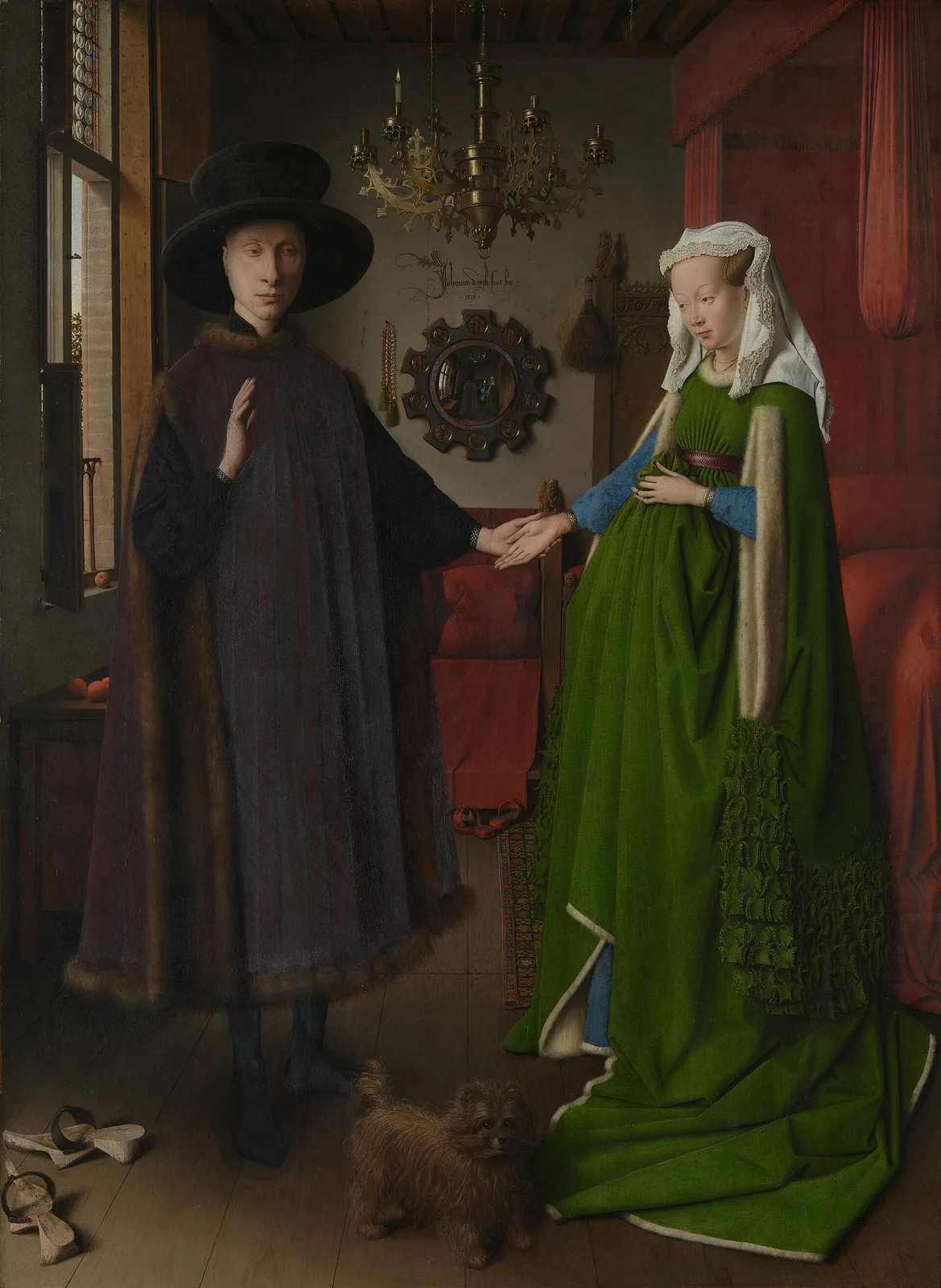

Las Meninas Explained: The Royal Couple in the Mirror
Who appears in the mirror in Las Meninas, and where are the king and queen standing? Follow Velázquez's figures, sight lines, light, doorway, and self-portrait.

Las Meninas appears to show an ordinary interruption in a royal room: a princess stands among her attendants, Velázquez pauses at a towering canvas, the king and queen appear in a mirror, and a palace official occupies an open doorway. Yet many of the figures respond to the same place outside the painting. That unseen position belongs to the monarchs within the scene and overlaps with the position from which we view it. Follow the sight lines one by one, and a court portrait becomes a precise investigation of who sees, who is seen, and what a painting can leave outside its frame.
Las Meninas stages a court group inside a real palace room
Velázquez set the scene in the Prince's Room of the former Alcázar in Madrid. Painted in 1656, the enormous canvas measures approximately 320.3 by 279.1 centimeters. Its figures approach the viewer's scale, so the architecture does not feel like a distant miniature. Floor, ceiling, windows outside the frame, paintings on the rear wall, and the open doorway establish a room that seems to continue around us.
At the center is the five-year-old Infanta Margarita Teresa. One lady-in-waiting offers her water while another inclines toward the group. At right, Nicolasito Pertusato places a foot against a large dog. At left, Velázquez looks up from his work. In the distance, José Nieto pauses on a step. These are concurrent actions rather than the synchronized stillness of a ceremonial portrait.
The reason for the interruption lies beyond the painted room. The princess, the painter, and others direct attention toward the front. A mirror on the rear wall contains Philip IV and Queen Mariana of Austria, neither of whom otherwise enters the room we see. The cause is outside the frame; the responses are inside it.
The Museo del Prado uses the title The Family of Felipe IV, or Las Meninas. The familiar Spanish name means the ladies-in-waiting, but the work encompasses more than attendants or even the princess. It joins the royal family, court service, artistic labor, and the viewer within one visual system.
Most of the people in Las Meninas can be identified
| Figure | Position and action | Role |
|---|---|---|
| Infanta Margarita Teresa | Center, in white and silver | The five-year-old daughter of Philip IV and Mariana of Austria |
| María Agustina Sarmiento | Kneeling at the princess's left | A lady-in-waiting offering water in a small red vessel |
| Isabel de Velasco | Standing at the princess's right | A lady-in-waiting bending toward the group |
| Mari Bárbola and Nicolasito Pertusato | Right foreground beside the dog | Members of the Spanish court; Nicolasito nudges the mastiff |
| Diego Velázquez | Left, behind a large canvas | The painter pauses with brush and palette |
| José Nieto Velázquez | Open doorway at the rear | A palace official and attendant to the queen |
| Philip IV and Mariana of Austria | Reflected in the rear mirror | The king and queen occupy the unseen space in front of the scene |
Antonio Palomino's published description of 1724 became an important source for identifying the court figures. Written around seven decades after the painting, it is not a contemporary label attached to the canvas, but the Prado uses this evidence in its account of the work.
The princess's wide white-and-silver dress creates the largest light shape. María Agustina Sarmiento kneels on the left and offers a small red cup or vessel. Isabel de Velasco bends on the right. They are the meninas, attendants associated with the queen's household.
Mari Bárbola and Nicolasito Pertusato were real people employed at the Spanish court, not invented comic accessories. Nicolasito's contact with the dog measures a tiny unit of time: pressure has been applied, but the mastiff has barely responded. Farther back, Marcela de Ulloa and another attendant form a layer of adult supervision in half-shadow.
José Nieto is the smallest named figure because he is farthest away, yet the bright doorway gives him unusual clarity. His body connects three distances: Velázquez in the foreground, the princess in the middle ground, and the staircase at the rear. Knowing names helps, but positions and actions explain why the room feels inhabited.
The mirror contains Philip IV and Mariana of Austria
Among the dark framed paintings on the back wall, one small rectangle shines. The two reflected heads belong to King Philip IV and Queen Mariana of Austria, the parents of the Infanta. Their identity is not merely one speculative solution among many; it is stated by the Prado.
The mirror differs from the pictures around it. The royal couple appears as a pale reflection rather than as firmly painted figures within another framed scene. The open doorway nearby describes conventional depth with floor, steps, and a standing body. The mirror does something stranger: it folds people from the unseen foreground back onto the rear wall.
The Prado explains the room as a moment when the monarchs arrive or watch, causing people around the princess to pause. Under that reading, Philip and Mariana stand on our side of the picture, in the direction Velázquez faces. The reflection makes an off-canvas presence visible and gives the apparently casual gestures a common cause.
It is still important to distinguish identity from optical geometry. Some interpretations propose that the mirror reflects a portrait of the monarchs on Velázquez's hidden canvas rather than their bodies. The canvas surface cannot be seen, and a painted image does not let us physically measure every ray of light in the represented room. This guide uses the Prado's reading as its baseline while leaving the exact reflected path open.
We cannot see what Velázquez is painting on the large canvas
Velázquez stands at the left with a brush and palette. The canvas before him is taller than a person, but its back faces us. Is he painting Philip and Mariana, the princess's group, or a different work? The visible evidence does not disclose the subject.
The hidden surface matters more than a guessed answer. Because the painter looks forward, his model occupies space outside the picture. Because the mirror contains the royal couple, that outer space acquires named occupants. And because we stand in front of the work, the painter's inspecting gaze also reaches us. Looking at Las Meninas means briefly entering the place from which its visible world is organized.
The canvas also has a compositional job. Its dark reverse blocks the left side like a wall. Velázquez emerges beside that plane while the room opens toward the bright princess and deep doorway. Without it, the artist might dissolve into the group. With it, the act of making a picture becomes a subject in its own right.
Do not rush to fill what the painting withholds. The method used in The Starry Night explained—separating direct observation, documentary evidence, and reconstruction—is equally valuable here. “The canvas faces away” is evidence. “It must show the royal couple” is a possible inference.
The viewer temporarily occupies the royal couple's side of the room
Not every figure stares at one mechanically identical point. Velázquez looks outward as if measuring a subject. The princess turns slightly. Her attendants continue their tasks, and the adults in the middle distance appear caught in conversation. The variations make the scene feel like a reaction spreading through time, not a cast frozen by one command.
The reflected monarchs nevertheless establish a privileged region in front of the scene. Standing before the painting, a viewer overlaps spatially with Philip and Mariana. We do not literally become Spanish royalty, but we borrow the compositional role of the people whose arrival or presence reorganizes the room.
Reducing this to “the viewer is the king” loses the productive tension. In a museum, many people can stand at different distances and heights, and the painted gazes continue to address each of them. The picture constructs a historically specific royal viewpoint while remaining open to an indefinite future public.
The Prado connects the mirror with questions about representation, the boundary between picture and reality, and the viewer's own role. It is both a courtly clue and a machine for returning our attention to the act of looking. Las Meninas does not only ask what we see. It makes us notice that the room seems to see us back.
The open door, perspective, and several light sources make the room tangible
The open doorway is brighter than the mirror. José Nieto appears dark against illuminated steps and wall, so his small silhouette remains legible at the greatest represented distance. The doorway is not a terminal surface. It promises more palace beyond the room.
If floor and ceiling lines are extended, they guide the eye toward the doorway region. Spatial focus and narrative focus are not identical: the princess commands the central light, while José Nieto anchors depth. Velázquez can therefore maintain a hierarchy of people without making architecture collapse into a backdrop.
There is more than one light source. Windows outside the right edge illuminate the foreground and central group. A separate rear light enters through the doorway. The mirror returns a faint image from the unseen foreground. The Prado describes both geometrical and atmospheric perspective as essential to the room's construction.
The princess's dress is bright but not a cutout of pure white. Silver gray, cream, dark ornament, skin, and reflected color soften its boundary. Distant figures lose contrast as though air stands between them and us, while the backlit doorway figure regains an edge. Depth is produced by changing clarity as much as by converging lines.
Former Prado technical specialist Carmen Garrido described the sensation of walking toward Las Meninas as if entering its room. The effect is grounded in scale, connected floor space, the far door, and gazes directed out of the canvas. Our bodily approach completes a spatial proposition already built into the painting.
Velázquez represents painting as judgment, not just manual work
Velázquez is both the author of the canvas and a court official inside its represented world. He holds tools but is not shown touching brush to surface. The selected instant is a pause: he looks, assesses, and decides what the next mark should be.
The Prado's accessible interpretation connects this self-presentation with the status of painting as an intellectual and conceptual activity, not only a manual craft. In seventeenth-century Spain, that distinction mattered to a painter's social position. Attention and judgment become visible even though the painted image on his own canvas remains hidden.
His self-portrait is not a tiny signature at the margin. He stands upright at nearly the princess's scale. That need not mean he claims equality with the royal family. He was a palace employee who worked near the king and helped manage the production and display of images. The painting joins that real office with an argument about the dignity of art.
Connect the large canvas, the central princess, and the rear mirror. They establish making, royal subjecthood, and authority within one room. Who makes an image, who can be represented, and who is allowed to look are not abstract questions added by modern viewers; they are embedded in the painting's social arrangement.
Separate established facts from compelling but unsettled interpretations
| Question | What can be stated | Basis |
|---|---|---|
| Who is in the mirror? | Philip IV and Mariana of Austria | The Museo del Prado identifies the reflected couple |
| Where does the scene occur? | The Prince's Room in the Alcázar of Madrid | The room is documented and represented with recognizable features |
| What is on Velázquez's canvas? | Not visible | Only its back faces us, so any subject is an interpretation |
| What exactly does the mirror reflect? | The royal couple, but the precise optical path is debated | Identity is secure; geometry depends on assumptions outside the visible surface |
| Why do the figures pause? | The Prado reads them as responding to the monarchs' arrival | This is the museum's scene-level interpretation, not a caption written by Velázquez |
Las Meninas has accumulated a vast interpretive history. Treating every detail as an unsolved mystery makes a lively article, but it can place documented identities and later philosophical proposals on the same evidentiary level.
Begin with what can be fixed: date, place, dimensions, material, most figures, and the identities in the mirror. Next comes the Prado's supported account of the scene, in which the monarchs' presence interrupts activity around the princess. Beyond that are open questions about the hidden canvas, exact reflection, political meaning, and the artist's ambitions.
Multiple interpretations do not mean that anything goes. Each claim can return to visible evidence. A mirror proposal should account for the mirror, canvas, gazes, and room. A political argument should account for the relative light, scale, and placement of royal and nonroyal bodies. A story that cannot reconnect with the surface remains a story, however elegant.
This distinction is also useful with famous works whose reputations invite one-line explanations. Girl with a Pearl Earring becomes more interesting when scientific findings about its background and painted “pearl” are kept separate from imagined biography.
The 1984 restoration recovered differences hidden by amber varnish
Las Meninas underwent a major cleaning and restoration in 1984. Prado records indicate that the paint layer was generally well attached and did not suffer the catastrophic weakness some observers feared. The surface, however, carried thick natural-resin varnishes from different periods. Yellowing and clouding pulled diverse colors toward a uniform amber cast.
John Brealey led the removal of the old varnish, after which Prado conservators completed necessary retouching and finishing. Cleaning recovered distinctions among blue, red, silver gray, flesh, and graded shadow. The cool atmosphere now visible is evidence that Velázquez did not simply paint a brown court interior.
This was not a repainting designed to make colors fashionable. Conservation asks which altered later layers can be removed without disturbing original paint. X-radiography, infrared examination, and pigment analysis conducted around 1982 informed the treatment. Material study placed boundaries around the intervention.
A bloom or whitish cloud later appeared on the newer varnish in 1986; records describe its transparency being restored through careful surface treatment. Conservation did not end with one dramatic unveiling. The canvas seen today joins Velázquez's 1656 materials, older coatings, the 1984 treatment, later monitoring, and current display conditions.
Begin with the princess and end by reconsidering your own position
- Find Infanta Margarita and the two ladies-in-waiting
- Move right to Nicolasito's foot and the unhurried dog
- Follow Velázquez's outward gaze toward your own side of the frame
- Locate Philip and Mariana in the small rear mirror
- Move to the open door and José Nieto beside the staircase
- Trace floor and ceiling lines to feel the room's depth
- Return to the princess and ask whether the same person still seems to be the sole subject
With the original or a high-resolution image, do not begin by checking every name. First find three lights: the princess, the mirror, and the doorway. Then connect them with gazes and roles. The change in your own looking before and after identification is part of what the work makes available.
When using the painting as a desktop image, its near-vertical format requires deliberate cropping. The MacBook wallpaper resolution guide explains why pixel dimensions and aspect ratio matter more than a vague “high resolution” label.
Las Meninas does not end when the mirror is decoded. The people inside the room, the unseen monarchs, the working painter, and the present viewer are tied together by lines of attention. Each time seeing and being seen exchange places, a private chamber in the Alcázar opens again in a public museum—or on the screen in front of you.
Live with a painting that rewards more than one look
Art4 lets you explore public-domain art by artist, movement, and theme, then bring carefully selected works to your Mac as a changing daily background.
Primary collection and conservation sources
Keep a painting like this on your Mac
Art4 lets you browse public-domain paintings by artist, movement, color, and screen shape, read the story behind each one, and set it as your wallpaper, or let it rotate on its own. Try it free for 7 days; if you keep it, it’s a one-time $14. Requires macOS 14 or later, or Windows 10 or later.