
Why Is the Mirror Wrong in Manet's A Bar at the Folies-Bergère?
The Courtauld says Manet shifted the barmaid's reflection, ignoring perspective. X-rays show he repainted it twice; a scholar's reconstruction fits most of it.
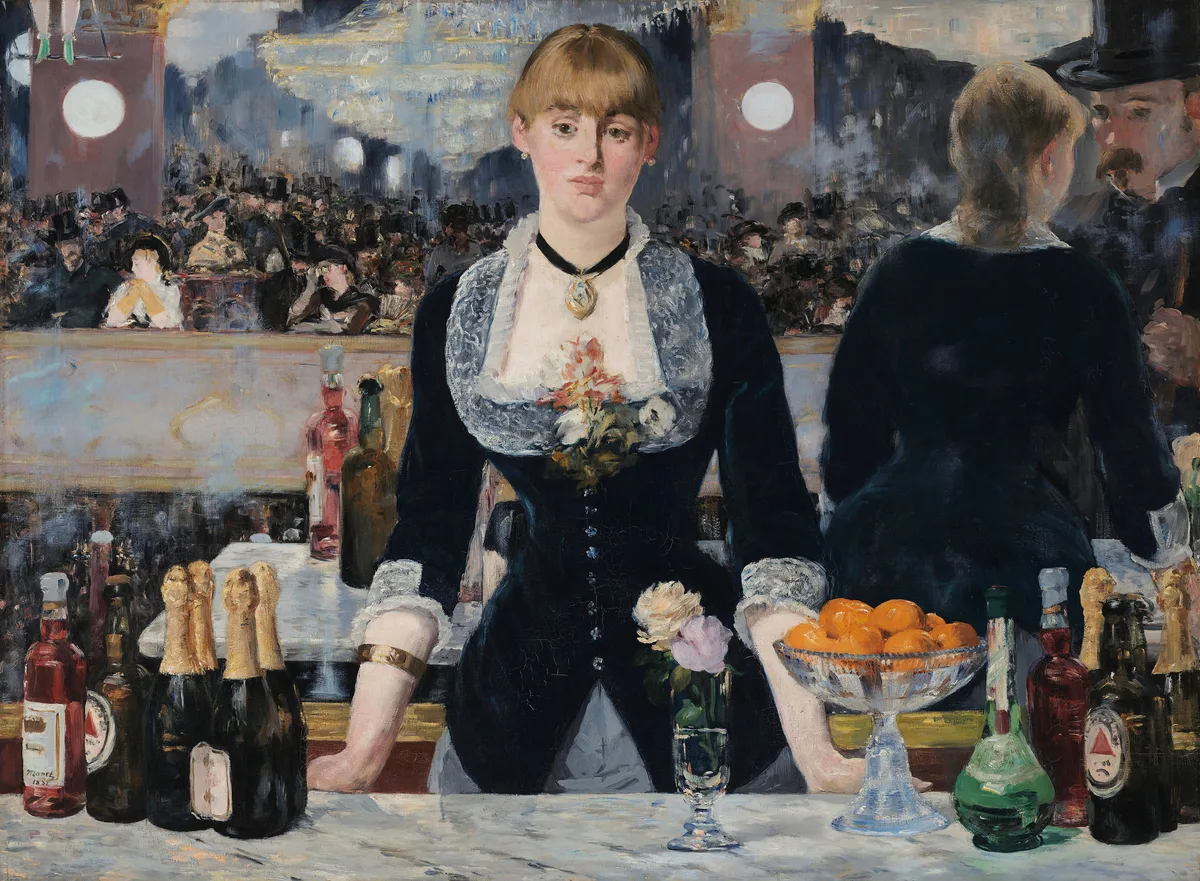
In A Bar at the Folies-Bergère the barmaid faces us, yet in the mirror behind her she faces a man in a top hat, and the pair appear far off to the right. The Courtauld in London, which owns the painting, says Manet shifted their reflection “ignoring normal perspective,” and that the mismatch adds to the disorienting atmosphere of a busy music hall. X-rays show he repainted her reflection twice, and one scholar argues that most of the scene adds up if you stand to the right of the bar.
Why is the mirror wrong in A Bar at the Folies-Bergère?
According to the Courtauld, Manet shifted the reflection to the right, ignoring normal perspective, and the mismatch “emphasises the disorientating atmosphere” of a busy music hall. The gallery's text says: “Ignoring normal perspective, Manet has shifted their reflection to the right. The bottles on the left are similarly misaligned in the mirror.”
A technical study from the Courtauld Institute's conservation department, published in 2018, found that Manet changed the reflected barmaid twice as he painted. Whether the scene could exist in a real room is a separate question.
A Bar at the Folies-Bergère at a glance
| Item | Detail |
|---|---|
| Title | A Bar at the Folies-Bergère |
| Artist | Édouard Manet (1832–1883) |
| Date | 1882 |
| Medium and size | Oil on canvas, 96 × 130 cm |
| Collection | The Courtauld Gallery, London, P.1934.SC.234 |
The Courtauld calls it Manet's last major painting, completed a year before he died and shown at the Salon of 1882. Samuel Courtauld gave it to the gallery in 1934. As of November 2026 it hangs in the LVMH Great Room on Level 3 of the Courtauld Gallery.
What does not add up in the mirror
When the J. Paul Getty Museum borrowed the painting in 2007, it set out the problem plainly: Manet seems to have painted the barmaid from directly opposite her, yet the reflections of the objects on the bar, and of the barmaid and her customer, contradict that viewpoint.
Among the questions its exhibition pages listed:
- If the man is in the mirror, why is he not standing in front of the bar?
- Why does the mirror show no trace of the balcony walkway where he, or we, would be standing?
- Why are the reflected figures and objects displaced so far to the right?
The Courtauld's own guide, which names the barmaid Suzon, turns the puzzle into a question about us: “If Suzon’s reflection shows that she is facing this man, then who are we? Could we be looking at the scene through his eyes?” It leaves the question open.
A reflection repainted twice
Manet went to the Folies-Bergère often and made sketches there, but he painted this picture entirely in his studio. According to the Courtauld, he set up a bar there and hired one of the barmaids, Suzon, to pose behind it.
Manet first painted the barmaid with her arms crossed at her waist, according to a 2018 paper in X-Ray Spectrometry, and he altered her reflected image twice; the changes show in the X-radiograph. Earlier positions of the reflected head are just barely visible in a map of the zinc in the paint. The paper does not say in which direction, or how far, he moved the figure. What it does show is that the reflection's position was worked out on the canvas, not fixed from the start.
The view from the right: Malcolm Park's reconstruction
Malcolm Park, an independent art historian based in Australia, argued that the more conspicuous “errors” fit a single viewpoint after all. The Getty presented his work in 2007 under the title “One Scholar's Perspective.”
With a photographic reconstruction made in 2000 and a diagram, Park showed that the scene can be built from a viewpoint to the right of the bar, with Manet painting only a small section of that wider view. In this reading the man stands outside the picture to the left and looks away from the barmaid. She is not square to us either: she stands slightly turned, facing the offset viewpoint.
The Getty points to one detail that still does not fit. Seen from the right, the reflected edge of the bar would tilt more sharply to the right. That edge is the clue that makes us think the vanishing point lies directly behind the barmaid, and the Getty calls it the painting's “most subversive perspectival violation.”
So there are two readings. The Courtauld says Manet moved the reflection and ignored normal perspective; Park argues that most of it fits a viewpoint to the right. Even so, the Getty's exhibition text, which presented Park's work, concludes that Manet seems not to have offered a single position from which the whole scene makes sense.
How to look at A Bar at the Folies-Bergère
- Start with the barmaid's face. Her hands rest on the edge of the marble bar and she looks straight at you.
- Move to the mirror on the right. There she is again, from behind, facing a man in a top hat with a moustache, cut off by the right edge.
- Look back at the front of the bar. The man who should be standing there is missing.
- Find the top left corner. The green boots of a trapeze artist hang in the mirror; the whole crowd behind her is a reflection.
- End at the bottle on the far left. Its label carries the signature “Manet 1882.”
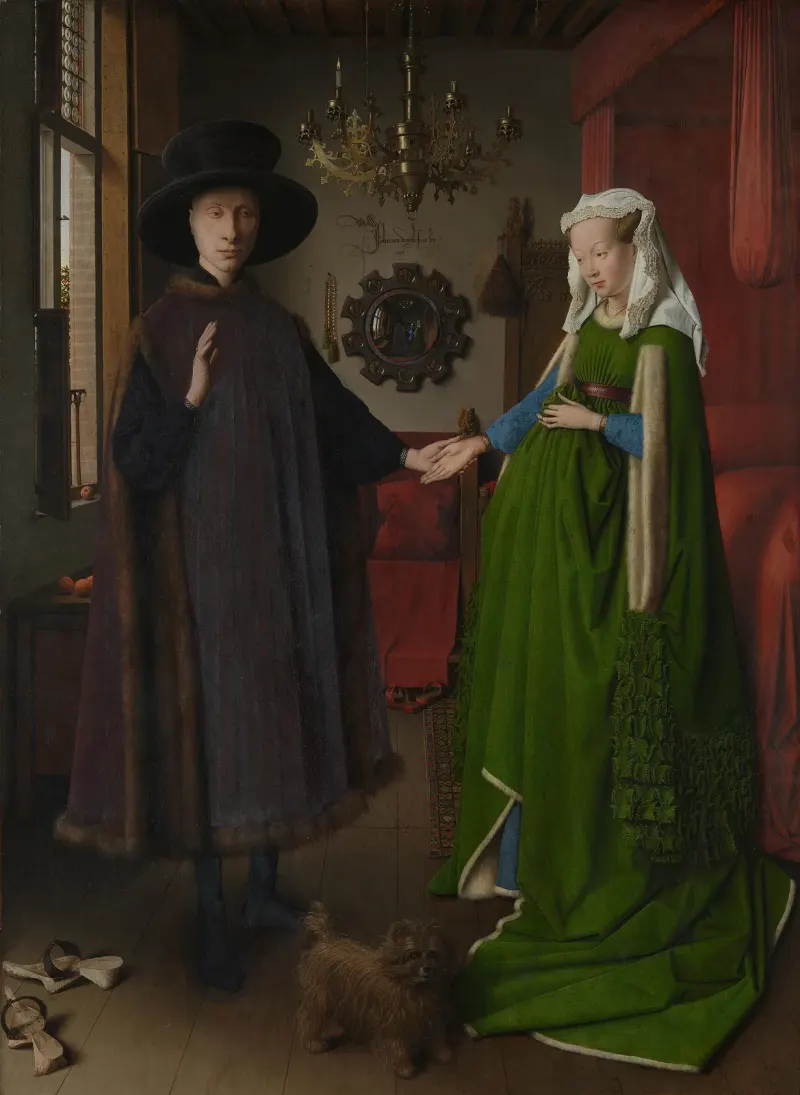
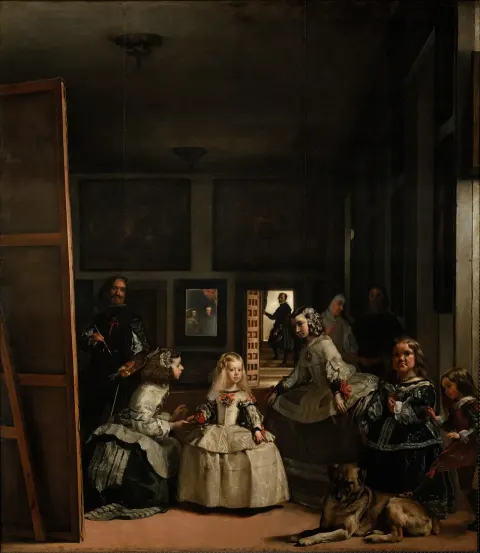
Mirrors change the meaning of a picture in Velázquez's Las Meninas and the Arnolfini Portrait too.
A night at the Folies-Bergère, on your desktop
A Bar at the Folies-Bergère is one of the paintings Art4 can set as your wallpaper. Choose by artist, period or theme.
Sources and image
- The Courtauld: A Bar at the Folies-Bergère, collection highlight
- Courtauld Gallery Collection Online: A Bar at the Folies-Bergère (P.1934.SC.234)
- The Courtauld, “A Closer Look – key information: A Bar at the Folies-Bergère” (PDF)
- J. Paul Getty Museum, Manet's Bar at the Folies-Bergère, exhibition pages (2007)
- J. Paul Getty Museum, “Manet's Bar at the Folies-Bergère: One Scholar's Perspective” (Malcolm Park's reconstruction)
- S. R. Amato et al., “Interpreting technical evidence from spectral imaging of paintings by Édouard Manet in the Courtauld Gallery,” X-Ray Spectrometry 48(4), 2019
- Image: Wikimedia Commons, Un Bar aux Folies-Bergère (public domain)
Keep a painting like this on your Mac
Art4 lets you browse public-domain paintings by artist, movement, color, and screen shape, read the story behind each one, and set it as your wallpaper, or let it rotate on its own. Try it free for 7 days; if you keep it, it’s a one-time $14. Requires macOS 14 or later, or Windows 10 or later.