
Is the Woman in the Arnolfini Portrait Pregnant?
Is the Arnolfini wife pregnant? The National Gallery says no. Why her gown has misled viewers since 1700, and what the mirror, signature, and candle show.
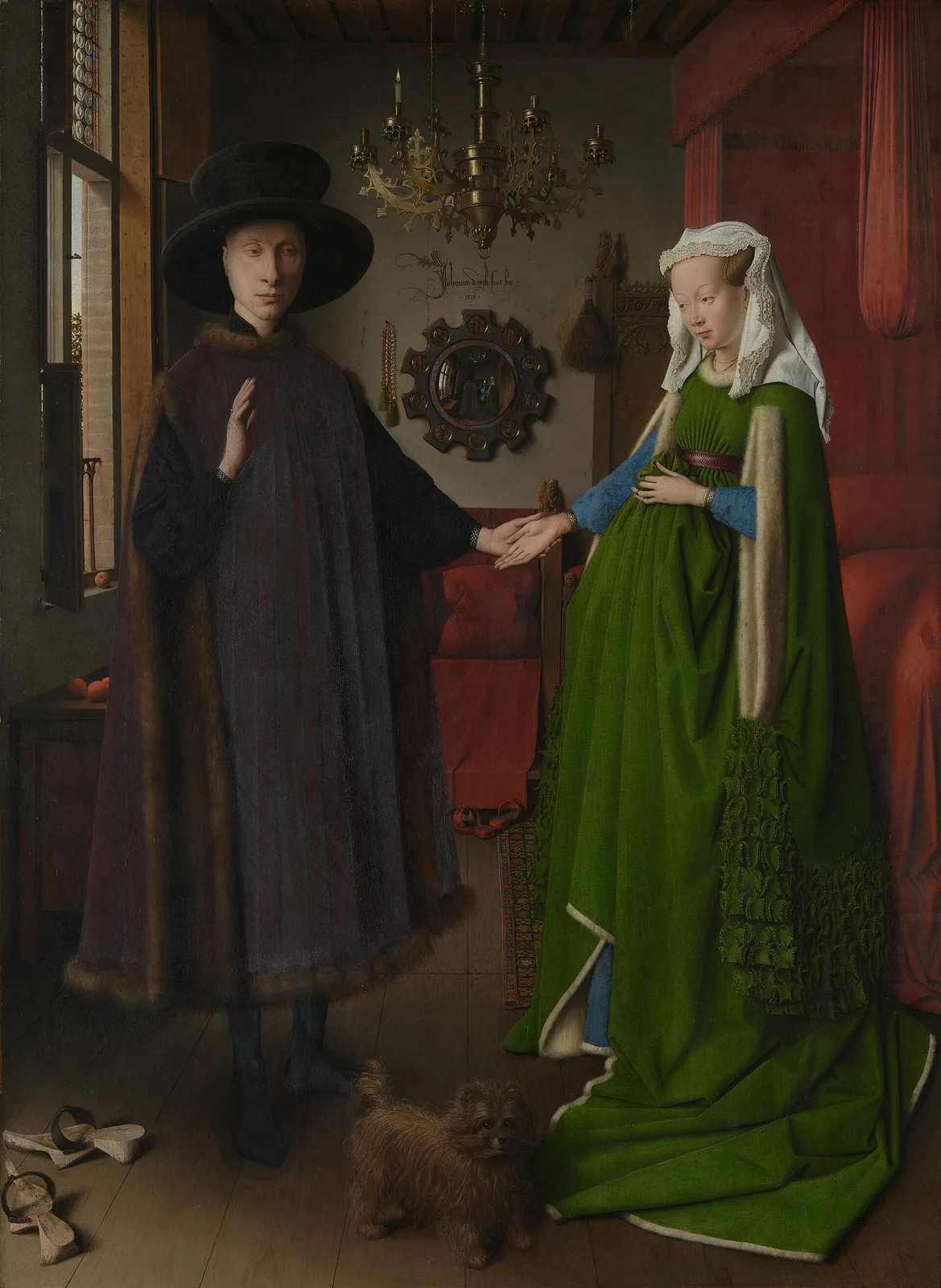
No. The woman in Jan van Eyck's Arnolfini Portrait is not pregnant, and the National Gallery in London, which owns the painting, says so plainly. She is holding up the front of a long, heavy gown, as well-dressed women of the time commonly did. Yet the painting has been described as showing a pregnant woman since at least 1700. Following that mistake turns out to be one of the best ways into the picture: it leads to the names that were rewritten, the mirror with two visitors in it, a signature on the wall, one candle burning in daylight, and a famous marriage theory that the museum itself no longer accepts.
The short answer: she is holding up her skirt
The National Gallery's collection page is direct about it: she is not pregnant, though she might look it. She is holding her bulky gown up in front of her, something women of her standing commonly did.
Look at her from the top down. A white veil frames hair dressed in two horns. Her green overgown is belted high, just under the bust, with a narrow red girdle. Below the belt the cloth balloons forward, and her left hand rests on that gathered mass. From her hand the fabric falls to the floor and spreads into a long train at the lower right, its hem edged with white fur.
The museum describes the gown as fine green wool, trimmed with white fur that may be ermine or squirrel belly. The sleeves are elaborately dagged, cut into layered scallops, and a blue underdress shows at her forearms. A dress this long cannot be walked in, or even stood in comfortably, unless the wearer lifts it.
Lorne Campbell, who wrote the National Gallery's scholarly catalogue entry on the painting, puts it in one sentence: to a modern eye she may look pregnant, but she is not. His comparison is telling. In van Eyck's Dresden triptych, the virgin martyr Saint Catherine is posed and dressed the same way and is, in Campbell's words, comparable in shape. If a virgin saint can wear this silhouette, the silhouette alone cannot signal a pregnancy.
Why so many viewers see a pregnancy anyway
The reading is easy to fall into, and it is worth separating what is on the panel from what we bring to it.
On the panel: the waistline sits directly under the bust, so there is no visible waist. The fabric below it projects outward. Her hand is laid on top of that projection. For a twenty-first-century viewer, a hand resting on a rounded stomach is almost a stock gesture for expecting a child, so the three cues snap together into a story. That last step is ours, not van Eyck's.
The story is also very old. The earliest version Campbell cites is in the inventory of the Spanish royal collection drawn up after the death of Charles II in 1700. Its compiler described a youth and a pregnant German woman dressed in green, giving him her hand, and added that they seemed to be marrying at night. Campbell suggests he was looking at a dirty picture in a dark room, and that the lit candle misled him into thinking the scene was nocturnal.
The idea stuck. Inventories made in 1808 and 1811, when Joseph Bonaparte ruled Spain, again describe the woman as pregnant. They also credit the painting to Holbein, which is a useful reminder of how unstable a painting's label can be. Once the painting was on show in London in the 1840s, Campbell notes, the notion of a pregnant "fallen woman" had real appeal for the Victorian public.
So the pregnancy is a reception story: an explanation that later viewers attached to the picture, not something recorded about the sitter. That does not make the question foolish. It makes it historical, and it is a good reason to slow down and check each detail. The same museum owns another picture built around a trick of seeing, which is covered in our guide to the skull in Holbein's The Ambassadors.
Who the couple probably are
The painting is smaller than many people expect: the painted surface measures 82.2 by 60 centimeters, in oil on a wooden panel that is probably oak. It is dated 1434, has been in the National Gallery since 1842, and carries the inventory number NG 186. Van Eyck, who worked in Bruges as painter to Philip the Good, Duke of Burgundy, died in 1441.
The National Gallery currently identifies the man as probably Giovanni di Nicolao Arnolfini, an Italian merchant working in Bruges, and the woman as probably his second wife, whose identity is unknown. Both "probably"s are deliberate.
The family name comes from early inventories rather than from anything written on the painting. The first recorded owner, the Spanish nobleman Diego de Guevara, gave the picture to Margaret of Austria, regent of the Netherlands. In her inventory of 1516 it is the first item, listed as a large picture called "Hernoul le Fin." A later inventory of 1523 to 1524 calls the sitter "Arnoult Fin." Campbell points out that these names may preserve an oral tradition or Guevara's own identification, so even the Arnolfini link rests on early testimony rather than a contract or letter.
What is better documented is the man himself. The Arnolfini were from Lucca, and many of them traded in northern Europe. Giovanni di Nicolao was living in Bruges by 1419 and sold cloth of gold and silks to Philip the Good. On 23 January 1426 he was betrothed to Costanza Trenta, who was then thirteen.
Two Giovannis, a 1447 wedding, and a wife who had died
For much of the nineteenth and twentieth centuries, the couple were identified as a different Arnolfini: Giovanni di Arrigo, with his wife Giovanna Cenami. The National Gallery's own 1995 technical study still carried that identification in its title, hedged with question marks: Giovanni(?) Arnolfini and his wife Giovanna Cenami(?).
That identification ran into the calendar. An archival reference found by the historian Jacques Paviot records that Philip the Good presented two silver pots to "Jehan Arnoulphin" on the day of his wedding, and Campbell's catalogue places Giovanni di Arrigo's marriage in 1447. That is thirteen years after the date on the wall, and six years after van Eyck's death. Whatever the painting shows, it cannot be this couple's wedding.
Attention therefore shifted to Giovanni di Nicolao, and a second date problem appeared. In a letter written from Lucca on 26 February 1433, Costanza Trenta's mother mentioned that her daughter was dead. The painting is dated 1434. If the man is Giovanni di Nicolao, the woman beside him in 1434 is either a second wife or not a living sitter at all.
The National Gallery takes the first view, while noting that her name is unknown. Campbell adds that Giovanni di Nicolao probably married again, but no reference to a second wife has yet been found. Some writers have proposed that the painting is a memorial image of Costanza; the museum's current label does not adopt that idea. The honest summary is this: the man is very probably Giovanni di Nicolao, the woman's name is lost, and neither candidate supports reading the picture as the record of a wedding in 1434.
The convex mirror: two visitors and ten Passion scenes
The round convex mirror hangs on the back wall, exactly between the couple. In its bulging glass the room bends around: the couple seen from behind, the window on the left, the red bed on the right, and beyond them an open door. Two men are coming through it.
Campbell describes their clothes. The man in front wears a blue chaperon, a draped hood, and a blue robe; the man behind him wears a red hat and a red robe. The front figure seems to raise his arm. At normal viewing distance they are a few strokes of color, and you need a high-resolution image or a close look in the gallery to find them.
Who are they? The National Gallery frames it as a question: are the men in the mirror van Eyck himself and his servant, arriving on a visit? Campbell reads the implication that the painter is the foremost of the two. That is an inference from the picture and from the inscription above it, not a documented fact, and it is best held that way.
The frame is its own miniature program. Ten roundels are set into it, each containing a tiny scene from the Passion of Christ. The sequence begins at the bottom with the Agony in the Garden and runs clockwise to the Resurrection. Campbell recalls that, for Saint Bernard, Christ's suffering body was a mirror for the soul, which makes the Passion a fitting subject for a mirror frame.
Even the size is a question. Campbell estimates the glass at no less than 28 centimeters across, which he calls extremely large, and says it is impossible to know whether Arnolfini owned so big a mirror or van Eyck enlarged it.
The painting spent roughly two and a half centuries in the Spanish royal collection and was recorded in the Alcázar palace in Madrid in 1599. Velázquez later painted Las Meninas in the same palace, with its own mirror reflecting people who stand outside the scene. No document says Velázquez studied this panel, but the comparison is made often, and our guide to the mirror in Las Meninas shows why.
Johannes de eyck fuit hic: a signature on the wall
Directly above the mirror, in looping Latin script, is the inscription "Johannes de eyck fuit hic 1434." The National Gallery translates it as "Jan van Eyck was here. 1434." Campbell prefers "Jan van Eyck has been here."
A signature normally sat on the frame or at the edge of the picture. Writing it on the wall of the depicted room is, in Campbell's words, altogether exceptional. Here the signature behaves like writing that actually exists in the space, in the same way the mirror shows a space that actually extends behind us.
The two features line up vertically, and that is hard to ignore. Above: words saying the painter was here. Below: a reflected figure entering the room. Read together, they suggest that van Eyck put himself in the picture twice, once as text and once as image. That is a strong reading, but it is a reading.
Two older interpretations of the inscription have fared worse. A few art historians once took it to mean "Jan van Eyck was this man," making the couple the painter and his wife Margaret. Campbell calls this unacceptable and notes that the man does not resemble the panel in the National Gallery thought to be van Eyck's self-portrait. The other interpretation treats the inscription as a witness's legal signature. Campbell answers that the decorative script was used for any elaborate inscription, and that the formula "fuit hic" does not appear in legal documents.
Candle, oranges, dog, shoes, and bed: what is documented and what is read in
| Object | Where to look | What is documented | Interpretation |
|---|---|---|---|
| Candle | Brass chandelier, top center | One lit candle in a six-branched chandelier, in a daylit room | Read as a marriage candle since 1934, without supporting evidence |
| Oranges | Windowsill and chest at left | An expensive fruit at the time | The museum reads them as a display of wealth |
| Dog | Between the couple's feet | A small brown dog; absent from the first stage of underdrawing | A sign of marital fidelity, a household pet, or both |
| Shoes | Lower left and back of the room | His wooden-soled pattens and her red leather pattens | The holy-ground reading is now doubted: these are outdoor overshoes |
| Bed | Right side | The most expensive furniture in the house | It belongs to a reception room, not a bedroom |
| Saint Margaret | Carved on the chair back, right of the mirror | A saint associated with childbirth | Possibly a hope for children; not evidence of a pregnancy |
Start at the ceiling. The six-branched brass chandelier holds a single lit candle, even though daylight is coming through the window at the left. The museum's audio description also notes a second candle that has been snuffed out. The single flame has attracted more symbolic readings than almost anything else in the picture, but no document from the period is known to explain it.
Then the window. One orange sits on the sill and more lie on the chest beneath it. Oranges were very expensive at the time, and the National Gallery reads them as a sign of wealth. More broadly, the museum says every object was chosen to proclaim the couple's wealth and status without risking criticism for aping the aristocracy. That phrase is a good lens for the whole room: costly, but carefully not princely.
At the couple's feet stands a small brown dog, looking straight out at us. The museum's audio description says dogs were a common symbol of faithfulness in marriage; Campbell describes this one as clearly a household pet. These are not contradictory. A real pet can be painted precisely and still carry a familiar association.
The shoes are easy to miss. At the lower left lie the man's wooden-soled pattens, outdoor overshoes still spattered with mud. Further back, near the rug, is a second pair covered in red leather, which Campbell identifies as hers. Both are things you strap over your shoes to walk through dirty streets and take off indoors.
The bed at the right persuades many people that this is a bedroom. The National Gallery says it is not: this is a reception room, and the bed, the most expensive piece of furniture in the house, was an essential part of its furnishings.
Finally, look at the high chair back to the right of the mirror, near the hanging brush. Its finial is a small carved figure that Campbell identifies as Saint Margaret praying, with her dragon. The National Gallery's glossary calls Saint Margaret the patron saint of childbirth and points to this very statuette. Here, at last, is a genuine link to childbearing in the painting. It may express a hope for children. It does not show that the woman is carrying one.
Is it a marriage certificate? Panofsky's theory and why it is now doubted
The most influential reading of the twentieth century came from the art historian Erwin Panofsky in 1934. He argued that the panel records the private marriage of Giovanni di Arrigo Arnolfini and Giovanna Cenami. In his account, the two figures in the mirror are witnesses, the signature is a witness's attestation, the man's raised hand is an oath, and objects such as the candle and the removed shoes carry sacramental meaning. He called the result a pictorial marriage certificate.
It is an elegant theory, and it shaped how the painting was taught for decades. The National Gallery now says the painting was long understood as a marriage ceremony, "though not anymore." The objections come from several directions:
- The couple: the Giovanni di Arrigo whom Panofsky had in mind did not marry until 1447.
- The gesture: Campbell notes that the Latin term Panofsky gave for the oath gesture was his own invention. The museum describes the raised hand as apparently a greeting.
- The signature: the script is decorative rather than legal, and "fuit hic" is not a legal formula.
- The setting: this is a reception room, and the men in the mirror read naturally as visitors.
- The making: many of the supposedly symbolic objects were not part of the original underdrawing.
The hands themselves are worth checking. The couple are not clasping right hands. The man holds out his left hand, palm up, and she rests her right hand lightly in it, while his right hand is raised. Campbell concludes that the hypothesis of a marriage or betrothal can be rejected, and that the panel should be treated as a portrait, without significant narrative content, of Giovanni di Nicolao and his second wife.
The marriage idea, like the pregnancy idea, is not new. A visitor from Leipzig who saw the painting in Madrid in 1599 wrote that the young man and woman were joining hands as if promising future marriage. By then the frame carried lines from Ovid's Art of Love about making promises, which the museum thinks were probably not original. A double portrait of a husband and wife is naturally about marriage in a general sense. What has collapsed is the claim that it documents a ceremony.
What infrared images show was added late
Infrared reflectography can see through the paint layers to the drawing beneath. In 1995, Rachel Billinge and Lorne Campbell published composite infrared images of the painting in the National Gallery Technical Bulletin. They found numerous changes to the faces and to the positions of hands and feet, and they showed that many details long considered central to the portrait's symbolism were painted at a late stage, without underdrawing.
The museum's collection page summarizes the sequence. The underdrawing was made in stages, and the first stage left out the dog, the chandelier, the chair, the beads, and the discarded shoes. The woman originally looked up toward her husband rather than down. Campbell's entry adds that no underdrawing has been found for the oranges, the beads, the two pairs of pattens, the dog, or the chandelier, and that the man's right hand was first placed further to the left with its palm showing.
None of this proves the objects are meaningless. It does sit badly with the idea of a symbolic program fixed in advance and then illustrated. The dog, the oranges, and the shoes look more like decisions made while the room was being built up on the panel, by a painter who could render the light in a string of amber beads and scratch the bristles of a hanging brush into the paint.
How to look at the Arnolfini Portrait, and why it resists a widescreen crop
- Start with her left hand and the gathered green cloth, then follow the fabric down to the train.
- Move to the joined hands: his left, her right. Compare them with his raised right hand.
- Zoom into the mirror and find the blue and red figures in the doorway.
- Trace the ten roundels from the Agony in the Garden at the bottom, clockwise.
- Read the signature above the mirror, including the date.
- Look up at the chandelier and count the lit candles.
- Drop to the floor: the dog, the muddy pattens at left, the red pair at the back.
- End at Saint Margaret on the chair back and the red bed, then step back to the whole room.
The pregnancy question begins at the woman's hand, but answering it carefully sends you everywhere else in the picture. Separating what you can see, what the documents say, and what interpreters have added is also how our guide to The Night Watch handles a famous title that misdescribes its own painting.
If you want this panel on a Mac, its shape works against you. The image is roughly 0.73 times as wide as it is tall, so filling a 16:10 screen keeps a horizontal band less than half the panel's height, about 46 percent. Take that band from the middle and it starts below both faces and cuts through the mirror. Slide it up far enough to keep the faces, the mirror, and the signature, and you lose the candle at the top and the dog and both pairs of shoes at the bottom. Nearly every clue in this article disappears one way or the other. Showing the whole panel with margins, or using a portrait-oriented display, keeps it intact. The MacBook wallpaper resolution guide explains how aspect ratio decides what a fill crop removes.
Keep the whole room in view, mirror included
Art4 includes the Arnolfini Portrait among its public-domain masterpieces, with the artwork information alongside, so you can keep it on your Mac and return to the gown, the mirror, the candle, and the shoes in a different order each time.
Primary sources and further reading
- National Gallery, London: The Arnolfini Portrait
- Lorne Campbell, National Gallery catalogue entry for NG 186 (1998, updated 2021)
- National Gallery: audio description of The Arnolfini Portrait
- National Gallery glossary: Saint Margaret
- Rachel Billinge and Lorne Campbell, infrared reflectograms of the portrait, National Gallery Technical Bulletin 16 (1995)
- National Gallery: Jan van Eyck (active 1422, died 1441)
Keep a painting like this on your Mac
Art4 lets you browse public-domain paintings by artist, movement, color, and screen shape, read the story behind each one, and set it as your wallpaper, or let it rotate on its own. Try it free for 7 days; if you keep it, it’s a one-time $14. Requires macOS 14 or later, or Windows 10 or later.