
The Starry Night Explained: What Van Gogh Saw and Invented
The Starry Night through Van Gogh's letters and MoMA research: the observed Venus and landscape versus the invented village and the compressed cypress.

The Starry Night is not a night scene painted directly from Van Gogh’s asylum window. He observed Venus and the hills before dawn, then worked in the daytime, adding a village that the window did not reveal and pulling a cypress close to the foreground. Its power comes from layering nature observed, places remembered, and forms deliberately rearranged.
Essential facts about The Starry Night
| Item | Detail |
|---|---|
| Artist | Vincent van Gogh |
| Date and place | June 1889, Saint-Rémy, southern France |
| Medium | Oil on canvas |
| Dimensions | 73.7 × 92.1 cm |
| Collection | Museum of Modern Art, New York |
Van Gogh entered the Saint-Paul-de-Mausole asylum at Saint-Rémy voluntarily in May 1889. He painted The Starry Night the following month. MoMA explains that it derives from the view through an east-facing window, but was produced in the studio over several sessions during the day.
That process contradicts the familiar story of a complete vision dashed down in one feverish night. The painting feels immediate, yet it is also selective and constructed: positions, distances, and relative scale have been changed.
What Van Gogh observed—and what he invented
| Element | Evidence | Status |
|---|---|---|
| Bright star before dawn | Recorded by Van Gogh in a letter; the scholarly edition identifies Venus | Documented |
| Ridge of hills | Based on the east-facing view from the asylum | Observed, then reconstructed |
| Village | Not visible from that window | Combined from another view or memory |
| Large foreground cypress | Brought closer and enlarged | Compositional change |
| One fixed meaning for the spiral | No surviving explanation by Van Gogh | Interpretation remains open |
In a letter written around the end of May or beginning of June, Van Gogh described looking from his window long before sunrise and seeing the countryside with one exceptionally large morning star. The scholarly notes identify that star as Venus.
The village below, however, could not be seen from the asylum window. Its church-centered arrangement does not record a precise site at Saint-Rémy. The cypress is also compressed into the foreground.
The result is neither pure fantasy nor a literal astronomical study. Observation supplies the nucleus; memory and composition determine the finished world.
The swirling sky turns light from a point into a force
Concentric rings surround the moon and stars, while a blue band crosses the sky between them. Strokes do not stop politely at the outlines of separate objects. They carry motion through the entire upper field.
MoMA identifies the moon at right and Venus left of center, while describing how Van Gogh transformed observed features and intensified their radiance. Elsewhere in his letters, he resisted the idea that a night sky could be represented merely by white dots on blue-black.
The useful claim is pictorial, not pseudoscientific: light is shown as an action spreading through space rather than as a stationary dot.
The cypress connects the near earth with the distant sky
The dark cypress rises from the bottom edge into the sky’s movement. Without it, the long sky, hills, and village would encourage a mainly horizontal passage. Its near-black vertical form interrupts that drift and provides a bridge between scales.
The village is built more quietly from short verticals and horizontals. Small lights, roofs, and the church spire appear slow and hard beside the sky’s broad curves. The tension belongs to the difference between sleeping ground and active atmosphere.
Cypresses are associated with cemeteries around the Mediterranean, so the form is sometimes treated as a symbol of death. The painting does not prove one fixed symbolic equation. First establish its compositional role; cultural associations can then remain possibilities rather than verdicts.
Blue and yellow contrast, but direction makes the night move
The sky is not one blue. Deep blue, blue-green, and lighter bands overlap; yellow, white, and pale green build the stars. Because blue and yellow approach a complementary contrast, the lights seem to advance more strongly than brightness alone would suggest.
The brushwork changes speed by subject:
- Long curves carry the eye around the sky
- Concentric strokes give each star a field of radiance
- Repeated contours let the hills echo the sky more faintly
- Short straights keep the village comparatively still
- Flame-like vertical strokes lift the cypress upward
From a distance these marks become a landscape. Up close they remain conspicuous tracks of paint. The combination is one reason Van Gogh’s path beyond Impressionism mattered. See Impressionism vs. Post-Impressionism for that larger comparison.
What does The Starry Night mean?
The letters and museum research support several facts: Van Gogh saw Venus before dawn, combined observation with invention, and cared intensely about the color of night. Awe, faith, mortality, and psychological pressure are possible interpretations, but no surviving key turns every element into one decipherable code.
Keep three layers separate:
- Observation: the sky occupies more area than the village; the cypress connects them; rings spread around the stars
- Documentation: Venus was observed; the village was not in the window view; the work was made during the day
- Interpretation: the moving sky may seem to press upon the quiet settlement
An interpretation becomes discussable when it can return to the first two layers. It does not need to become the only meaning.
A sequence for looking at The Starry Night
- Step back and compare the area given to sky, hills, and village
- Begin with bright Venus and follow the rings around the other stars
- Trace where the long blue band separates and rejoins
- Follow the cypress upward and compare its contour with the sky
- Look only at roofs, windows, church, and lights to feel their slower rhythm
- Move closer until each stroke reads as both landscape and paint
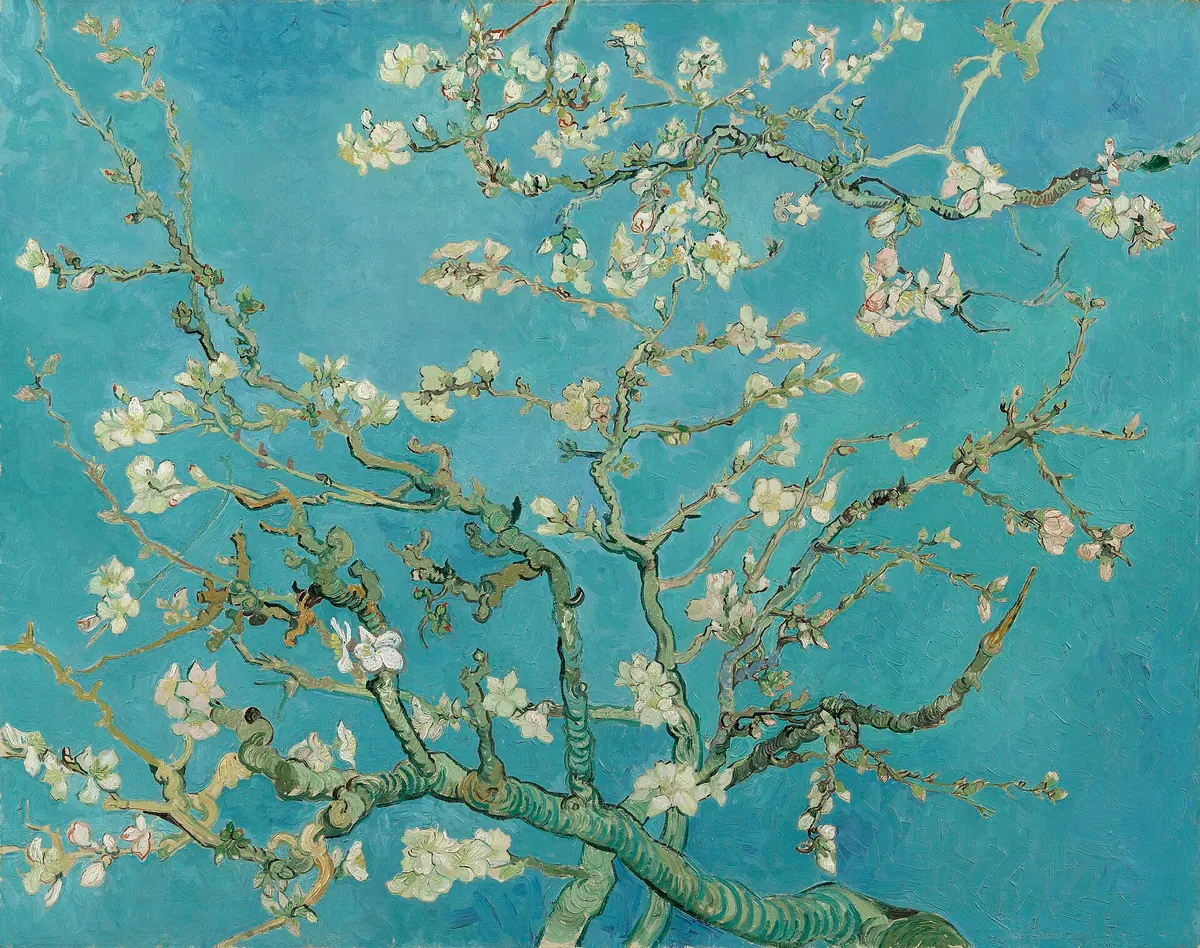
For another Van Gogh series shaped through repetition and revision, see how many Sunflowers he painted. For the calm painting he made at the same asylum the following February, see who Almond Blossom was painted for. As wallpaper, the canvas is narrower than a Mac screen. A MacBook set to Fill Screen keeps the full width, cypress and moon included, and cuts 18% of the height from the top of the sky and the village below. The Van Gogh wallpaper guide shows that crop and the wide canvases that fit a monitor better.
Primary sources and collection records
Keep a painting like this on your Mac
Art4 lets you browse public-domain paintings by artist, movement, color, and screen shape, read the story behind each one, and set it as your wallpaper, or let it rotate on its own. Try it free for 7 days; if you keep it, it’s a one-time $14. Requires macOS 14 or later, or Windows 10 or later.