
How Many Sunflowers Did Van Gogh Paint? Why the Answer Is 7 or 5
Van Gogh painted seven Arles vase compositions, and five major versions survive. The sequence, the repeats, the yellow experiment, and the Gauguin connection.

How many Sunflowers did Van Gogh paint? Count every Arles still life of flowers in a vase and the answer is seven. Count the principal large versions that survive and can be compared today and the answer is five. His earlier Paris paintings of cut flowers form a separate group. The numbers differ because the boundaries of the series differ.
Seven and five count different sets
| Answer | What is counted | What it includes |
|---|---|---|
| 7 | All vase still lifes painted at Arles in 1888–89 | Includes early small works, a lost painting, and repetitions |
| 5 | The principal surviving large compositions with 12 or 15 flowers | London, Munich, Amsterdam, Philadelphia, and Tokyo |
| More | Paris cut flowers, drawings, letter sketches, and printed reproductions | Usually separated from the Arles vase series |
The National Gallery states that Van Gogh painted seven vase compositions during his 1888–89 stay in Provence. Exhibition material also discusses five versions now distributed among London, Amsterdam, Tokyo, Munich, and Philadelphia.
Of the seven, the early composition with three flowers is privately held, while the painting with five flowers was destroyed in Japan during the Second World War. The five large surviving 12- or 15-flower compositions are the group most often reproduced together.
The seven Arles vase paintings include originals and repetitions
Van Gogh began with smaller compositions of three and five flowers, then moved to larger canvases with 12 and 15. In January 1889 he made repetitions of the major August 1888 compositions.
| Location | Date | Flower count | Background | Status |
|---|---|---|---|---|
| Munich | August 1888 | 12 | Blue-green | Original |
| London | August 1888 | 15 | Yellow | Original |
| Tokyo | January 1889 | 15 | Yellow-green | Repetition after the London composition |
| Amsterdam | January 1889 | 15 | Yellow | Repetition after the London composition |
| Philadelphia | January 1889 | 12 | Blue-green | Repetition after the Munich composition |
Flower counts in the titles are conventional and can vary with how buds, profiles, and damaged blooms are read. They are useful identifiers, not a botanical inventory. Background color, vase inscription, and the relation among flowers are often more reliable.
Van Gogh planned the paintings for Gauguin’s room
In August 1888 Van Gogh was preparing the Yellow House at Arles for Paul Gauguin. He wrote to his brother Theo about decorating the studio with Sunflowers and imagined the series as a symphony in blue and yellow.
This purpose changes the way we see the works. They were not isolated still lifes produced only for sale. Van Gogh imagined several canvases operating together in a room, surrounding a guest and giving the Yellow House an artistic identity.
Gauguin arrived in October. Their collaboration ended painfully in December, but the decorative plan remained central enough for Van Gogh to return to the compositions in January.
The yellow versions build light without traditional shading
In the London painting, flowers, vase, tabletop, and background all occupy related yellows. Objects remain distinct because Van Gogh changes hue, saturation, outline, and the direction of marks rather than relying on a simple dark-to-light model.
Fresh petals radiate; seed heads form rough disks; curling leaves and drying blooms point downward. The series includes growth and decay at once. Thick touches create a physical surface, though some of the most prominent raised marks have also changed and flattened with age.
Chrome yellow pigments made this range possible but can be chemically vulnerable. Material research helps explain why present color is not necessarily identical to the original appearance.
The 1889 repetitions are not mechanical copies
Van Gogh used the word répétition for new paintings after an earlier composition. He retained the broad arrangement while changing color, contours, individual flowers, and surface.
The Amsterdam and Tokyo works respond to the 15-flower London design; the Philadelphia work responds to the 12-flower Munich design. Repetition allowed Van Gogh to test what in the composition had to remain and what could be intensified.
Calling them “copies” can imply lower status or mere duplication. They are separate paintings made by the artist, with distinct decisions and histories.
The 1887 Paris Sunflowers are a separate series
Before Arles, Van Gogh painted cut sunflower heads lying on a surface in Paris. Those works lack the upright vase and the Yellow House decorative program. Gauguin owned examples and responded to them.
Including the Paris works makes the total larger, but it also mixes two different projects: horizontal studies of cut heads and the Arles vase sequence. When a source says “the Sunflowers series,” check which project it means.
How to distinguish the five principal surviving versions
- Start with the background: blue-green, yellow, or yellow-green
- Separate the 12-flower arrangement from the fuller 15-flower design
- Compare the vase and the placement of the signature “Vincent”
- Look at the topmost flowers and the large seed heads near the center
- Distinguish August 1888 originals from January 1889 repetitions
- Compare surfaces rather than expecting photographic identity
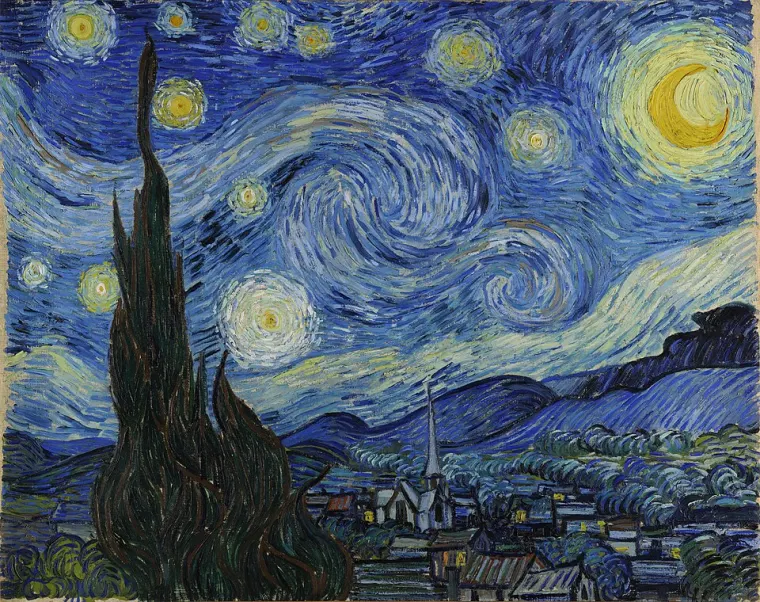
The National Gallery’s London version is an excellent starting point because its research connects technique, pigment, letters, and the larger series. For Van Gogh’s other great act of recomposition, read The Starry Night explained. For the larger art-historical context, compare Impressionism and Post-Impressionism.
Primary sources and collection research
Keep a painting like this on your Mac
Art4 lets you browse public-domain paintings by artist, movement, color, and screen shape, read the story behind each one, and set it as your wallpaper, or let it rotate on its own. Try it free for 7 days; if you keep it, it’s a one-time $14. Requires macOS 14 or later, or Windows 10 or later.