
How to Look at Abstract Art: A Seven-Minute Method
Learn how to look at abstract art by observing color, line, shape, repetition, space, and material. A practical seven-minute method for first-time viewers.

Do not begin an abstract painting by guessing the hidden subject. First ask where color gathers, how a line travels, which shapes repeat, and where the surface interrupts its own pattern. Once you collect visible facts, “I like it” and “I do not understand it” can become a precise account of what the work does.
Abstract art is not simply art that depicts nothing
Abstraction has degrees. A tree may be reduced to a rhythm of verticals; a figure may remain recognizable while its colors leave nature; a painting may consist only of relationships among lines, shapes, and material. Calling all of these “pictures of nothing” hides the artist’s choices about what to retain and what to remove.
Kandinsky’s earlier works can still contain riders, houses, and towers even as non-natural color begins to dominate. Mondrian did not start with red, blue, yellow, and black grids; he reached them through years of simplifying trees and landscapes.
A more useful first question is not “What is it?” but “How far has this work moved from ordinary appearance, and what remains?”
A seven-minute method for looking at abstract art
| Time | Focus | Action |
|---|---|---|
| 0:00–1:00 | Whole | Notice one place that attracts you and one you resist |
| 1:00–2:00 | Color | Find the largest, strongest, and most repeated colors |
| 2:00–3:00 | Line and shape | Follow straight and curved lines, edges, scale, and overlap |
| 3:00–4:00 | Movement | Trace where your eye stops and where it is sent next |
| 4:00–5:00 | Surface | Look for brushwork, thickness, gloss, support, and irregularity |
| 5:00–6:00 | Hypothesis | State one governing rule, then find one exception |
| 6:00–7:00 | Context | Read the title, date, and artist’s words; revise your first account |
The point is not to ban titles or wall labels. It is to form an observation before they steer your attention. If you read “war,” “silence,” or “cosmos” first, you may search only for shapes that confirm the phrase.
MoMA’s Slow Looking guidance similarly recommends giving a work time and considering color, form, line, texture, and the movement of attention. Seven minutes is not a rule; it is long enough for a first reaction to become a testable description.
Look at color, line, shape, repetition, space, and material
Color: study relationships, not just names
Instead of stopping at “there is red,” ask how much of the surface it occupies, what touches it, and where it repeats. The same red can flare beside white and recede beside black.
Line: treat it as movement
Does a line divide the surface or pass through it? Is a curve drawn in one motion or built from corrections? Following a line with your hand can reveal how the painting directs your eye.
Shape and repetition: find the exception
One angle among many circles or one narrow compartment among equal rectangles can become the focal event. A rule is often easiest to see where the work breaks it.
Space: count the “empty” areas
The distance between shapes and their pressure against the edge are active parts of the composition. Unpainted support can isolate, balance, or compress.
Material: recover what a screen removes
Thickness, stains, pencil marks, canvas weave, and changes in gloss disclose sequence and speed. A digital black may prove to contain several pigments and surfaces when viewed obliquely.
Kandinsky, Mondrian, and Abstract Expressionism are not the same abstraction
| Direction | Central concern | What to observe |
|---|---|---|
| Kandinsky | Color and line operate with a musical independence | Collisions, intensity, and the speed of marks |
| Mondrian | Verticals, horizontals, and limited colors create dynamic balance | Unequal areas, line weight, and off-center stability |
| Abstract Expressionism | Gesture, broad fields, and scale create bodily experience | Direction, edges, surface, and changes with viewing distance |
Kandinsky: color and line as independent forces
Kandinsky explored how color and form could act without merely explaining objects. If you recognize a possible subject, do not treat it as the solution. Compare it with the rhythm of lines and the changing intensity of color.
Mondrian: balance without symmetry
The vocabulary is limited, but the compartments are unequal. A large white area, a small red block, and lines of different weight pull against one another. Ask why the painting does not appear to tip even when its center is displaced.
Abstract Expressionism: include your body and distance
Large scale, bodily strokes, and broad fields change radically when reduced to a phone image. MoMA connects scale and the investigation of line, shape, and color with intense emotional or sublime experience. Receive the whole from a distance, then approach to see the act and material.
A personal interpretation can still have evidence
The absence of one narrative does not make every claim equally persuasive. If a painting feels anxious, identify what produces that response: pointed lines converging at the center, dark color closing the edges, or small forms compressed by larger ones. Another viewer might call the same arrangement concentrated rather than anxious, but both can discuss the shared evidence.
The artist’s statement is not a password that cancels looking. Intention, historical context, and material can narrow or deepen interpretation, while the visible work continues to matter.
Scale and surface make the original especially important
A reproduction of a figurative painting can at least preserve the placement of its people or landscape. In abstract work, physical size, paint thickness, reflected light, and viewing distance may carry much of the content.
Try three positions in a gallery:
- From the room entrance, compare the work with the wall and your body
- At a distance that contains the whole, study balance and color
- As close as the museum permits, inspect edges, layers, and support
Step back once more. The hand movements discovered up close should now connect with the total structure.
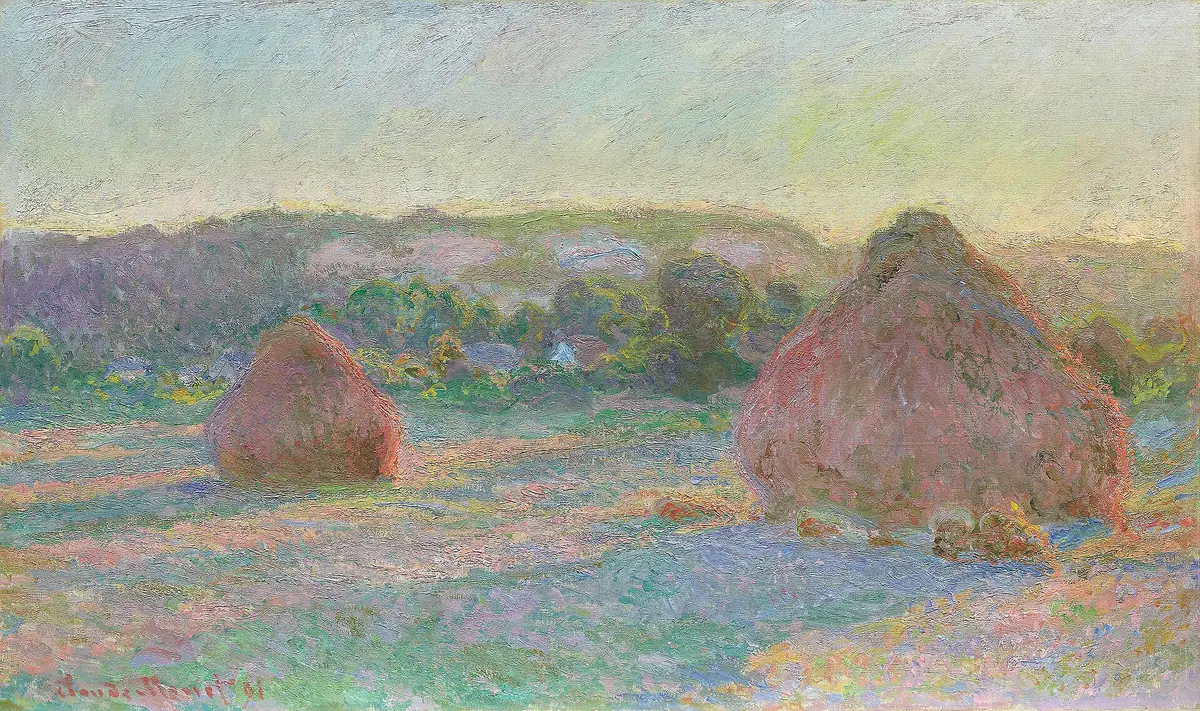
To see how color and visible brushwork became independent expressive tools before full abstraction, compare Impressionism and Post-Impressionism. For a figurative work whose curves and colors carry emotion beyond literal description, apply the same method to The Scream.
Three exercises you can try at home
Rotate the image 90 degrees
This is not a claim that orientation is arbitrary. Rotation temporarily interrupts the search for recognizable objects. Notice which weights, lines, and intervals survive, then return to the intended orientation and ask why it works better.
View it in grayscale
Removing hue exposes the pattern of light and dark. Restore color and notice which hues had been powerful despite similar brightness.
Diagram one rule
Record a simple pattern: five verticals, red at opposite corners, circles shrinking toward the center. You do not need to copy the art skillfully. Drawing makes repetition—and the exception that matters—easier to see.
Use these exercises as temporary lenses, not tests the artwork must pass.
Sources
Keep a painting like this on your Mac
Art4 lets you browse public-domain paintings by artist, movement, color, and screen shape, read the story behind each one, and set it as your wallpaper, or let it rotate on its own. Try it free for 7 days; if you keep it, it’s a one-time $14. Requires macOS 14 or later, or Windows 10 or later.