
Why Does the Madonna with the Long Neck Have Such a Long Neck?
Parmigianino stretched the Virgin on purpose. The Uffizi links her neck to the column beside her and a hymn, and explains why the altarpiece was never finished.
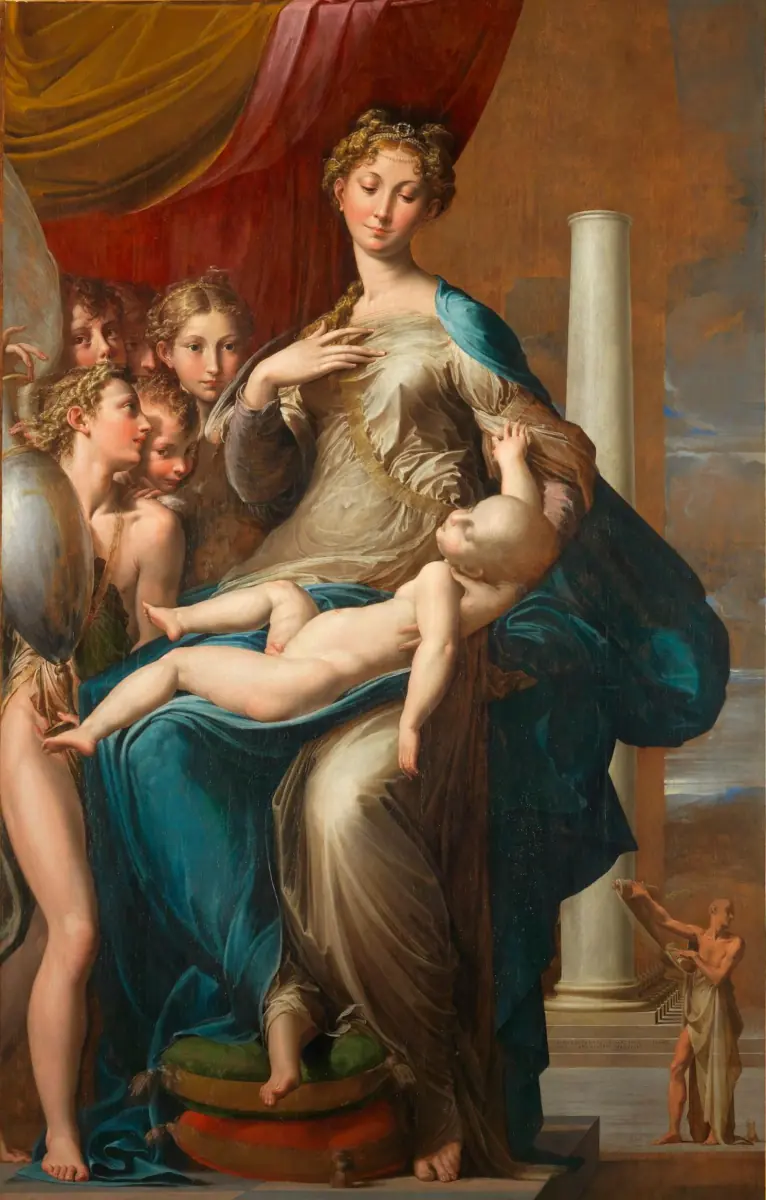
The Virgin's neck, her fingers and even the child on her lap are stretched far beyond normal proportions. The long neck in Parmigianino's Madonna with the Long Neck is not a mistake. The Uffizi, which owns the painting, describes a statuesque figure with unnaturally elongated forms, and says the column beside her emphasizes the suppleness of her neck. That column may also point to a line from a hymn to the Virgin.
Why does the Madonna have such a long neck?
The neck is long because Parmigianino stretched the figure on purpose. The Uffizi calls the Virgin a statuesque figure reminiscent of Michelangelo, but with unnaturally elongated forms.
Now look at the tall white column in the background on the right. The museum says this column, on Mary's left, highlights the suppleness of her bust and neck. It adds that the column could also refer to the purity of the Virgin as sung in the Marian hymn Collum tuum ut columna: "Your neck is like a column."
Two kinds of claim are mixed here. That the body is elongated, you can see for yourself. That the column alludes to the hymn is an interpretation, and the museum offers it with a "could."
Madonna with the Long Neck at a glance
| Item | Detail |
|---|---|
| Full title | Madonna and Child with Angels (Madonna with the Long Neck) |
| Artist | Parmigianino (Francesco Mazzola, 1503–1540) |
| Date | 1534–1540, left unfinished |
| Medium and size | Oil on panel, 216.5 × 132.5 cm |
| Museum | Uffizi Galleries, Florence |
Parmigianino's real name was Francesco Mazzola; his nickname comes from Parma, the town where he was born. The altarpiece is more than two metres tall, and it entered the Medici collections in 1698.
A Mannerist painting: elegance over harmony
Tate defines Mannerism as the style used by followers of Raphael and Michelangelo from around 1520 to 1600. These artists learned from the Renaissance masters but did not simply adopt their harmonious ideals. Instead they built highly artificial compositions that showed off their skill and created a sense of sophisticated elegance.
The Uffizi says Parmigianino trained in direct contact with Correggio in Parma, then studied the works of Michelangelo and Raphael in Rome. His intellectual, eccentric temperament led him to an elegant, sophisticated, anti-classic style, and he became the leading figure of Emilian Mannerism.
Set this Virgin next to a High Renaissance Madonna with balanced proportions and the difference is the point. Here the long neck and fingers put elegance itself on display.
The sleeping child and the angel's urn
The Christ Child is asleep on his mother's lap. According to the Uffizi, his sleep prefigures his death on the cross, and an image of the Crucifixion is reflected in the urn that an angel is showing to the Virgin.
The angels are crowded together on the left. The museum also points out a subtle sensuality, typical of the painter even in a sacred subject: the drapery clinging to the Virgin's body, the slender hand raised to her breast, and the bare leg of the young angel in the foreground.
The unfinished corner: one foot of Saint Francis
In 1534 Elena Baiardi Tagliaferri commissioned the painting for the church of Santa Maria dei Servi in Parma. In the contract, Parmigianino promised to finish it in five months. When he died in 1540, the altarpiece was still in his studio, unfinished.
Two years later it was placed on the altar it had been made for, and an inscription was added to the base of the column to explain its state: FATO PRAEVENTUS F. MAZZOLI PARMENSIS ABSOLVERE NEQUIVIT. The Uffizi translates it as "Adverse destiny prevented Francesco Mazzola from Parma from completing this work."
The small figure at the lower right is Saint Jerome, unrolling a scroll as he turns towards Saint Francis. Francis was never finished: the painter only had time to paint one of his feet.
A viewing sequence for Madonna with the Long Neck
- Compare the Virgin's neck with the height and slenderness of the column behind her
- Follow her long fingers from her face down to the hand at her breast
- See how far, and at what angle, the child stretches across her lap
- Among the angels on the left, find the one holding the urn
- Move to the lower right and find Saint Jerome with his scroll, and the single foot of Saint Francis
- Finally, find the inscription on the column base and remember why the painting was never finished
For another question about one painting, read Why is there a skull in The Ambassadors? For how Renaissance harmony looks before the Mannerists stretched it, see The Birth of Venus explained.
From the Renaissance to Mannerism, one painting a day
Art4 turns public-domain masterpieces such as Madonna with the Long Neck into Mac wallpapers, with the facts that go with them. Browse by period or artist and compare.
Sources and image credits
Keep a painting like this on your Mac
Art4 lets you browse public-domain paintings by artist, movement, color, and screen shape, read the story behind each one, and set it as your wallpaper, or let it rotate on its own. Try it free for 7 days; if you keep it, it’s a one-time $14. Requires macOS 14 or later, or Windows 10 or later.