

Why Did Monet Paint the Same Haystacks Again and Again?
Monet painted the stacks of wheat by his house at Giverny in 1890–91 to compare changing light. What Chicago's six show, and why the 1891 show was a hit.
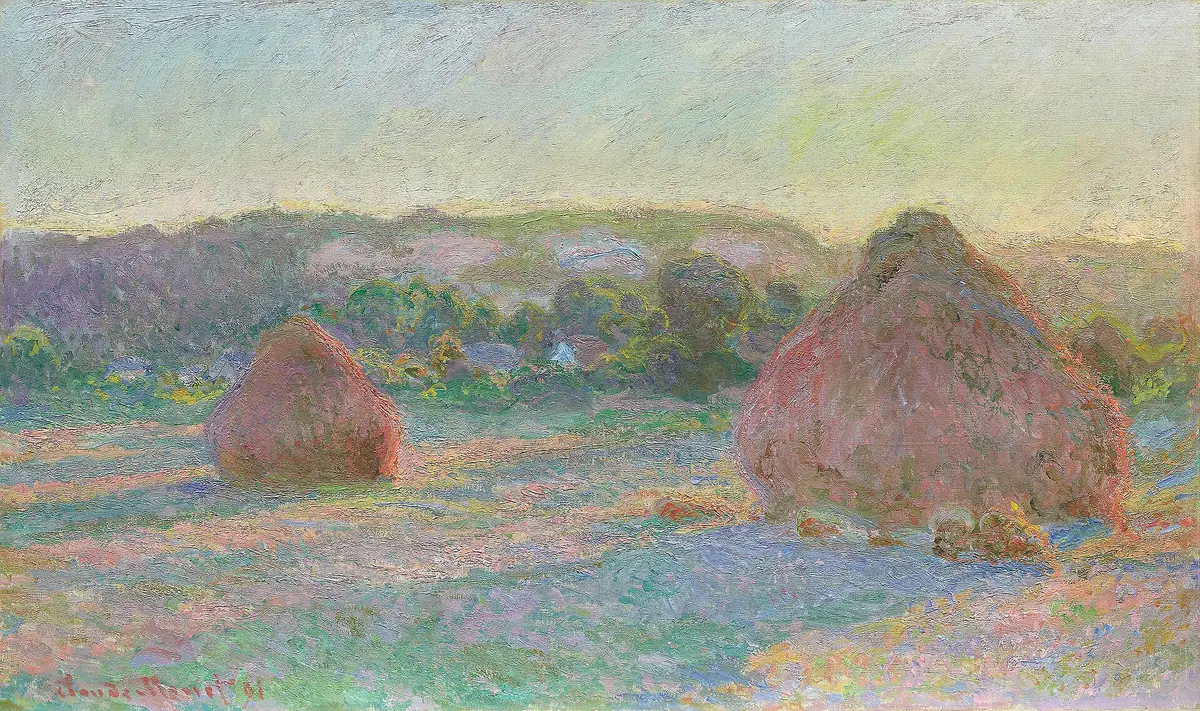
In 1890 and 1891 Monet painted the same stacks of wheat, in a field just outside his house at Giverny, over and over. With a subject whose shape barely changes, what changes from canvas to canvas is the light: the season, the hour, the weather. In May 1891 he hung fifteen of them side by side in one room, and the show was a critical and financial success.
Why did Monet paint the same haystacks again and again?
Monet painted the stacks again and again to record how the same subject looks in changing light. The Art Institute of Chicago says that of all the motifs Monet used to explore changing light effects, the grain stacks are among the most iconic. He painted them at various times of the year and at different moments of the day.
A stack of wheat is simple in shape and does not move. Put several of the paintings side by side, and most of what differs between them is the color of the light and the direction of the shadows.
The museum adds a second reason the motif mattered: for Monet, the stack was a resonant symbol of sustenance and survival. The series is an experiment with light, and it is also a picture of the harvest that rural life depended on.
Stacks of Wheat (End of Summer) at a glance
| Item | Detail |
|---|---|
| Title | Stacks of Wheat (End of Summer) |
| Artist | Claude Monet (1840–1926) |
| Date | 1890–91 |
| Medium and size | Oil on canvas, 60 × 100.5 cm |
| Museum | Art Institute of Chicago (1985.1103) |
In English the series is often called the Haystacks or the Grainstacks. The Art Institute of Chicago uses the title Stacks of Wheat, and that title finds its paintings fastest in the museum's collection.
A field by the house, several easels at once
The stacks Monet painted were monumental, fifteen to twenty feet high, and they stood just outside his farmhouse at Giverny.
According to the Art Institute, Monet worked on the series both in the field and in the studio. Outdoors he painted at several easels at the same time. In the studio he refined the color harmonies of each canvas.
Autumn and winter stacks look different
The Art Institute of Chicago has the largest group of Monet's Stacks of Wheat in the world. Its collection includes six of the oil paintings:
- Stacks of Wheat (End of Summer)
- Stacks of Wheat (End of Day, Autumn)
- Stacks of Wheat (Sunset, Snow Effect)
- Stack of Wheat (Snow Effect, Overcast Day)
- Stack of Wheat (Thaw, Sunset)
- Stack of Wheat
The museum gives one clue for comparing them. In nearly all of the autumn views, the conical tops of the stacks break the horizon and push into the sky. In most of the winter views, which form the core of the series, the stacks seem wrapped by bands of hill and field, as if bedded down for the season.
You can see the first case in End of Summer: the tip of the large stack on the right rises past the line of the hills into the sky. Put it next to a winter canvas, and the same shape seems to reach upward in one season and settle into the ground in the other.
Fifteen canvases in one room, 1891
In May 1891 Monet hung fifteen of the canvases next to each other in one small room at the Galerie Durand-Ruel in Paris. The Art Institute calls the exhibition an unprecedented critical and financial success, and a breakthrough both in Monet's career and in the history of French art.
The critic Octave Mirbeau wrote that the paintings conveyed "the drama of the earth."
Monet followed the stacks with more series: poplars, the facade of Rouen Cathedral, and later his own garden at Giverny. For the garden series, read How many Water Lilies did Monet paint?
A viewing sequence for Stacks of Wheat (End of Summer)
- Compare the size and position of the small stack on the left and the large one on the right
- Find the spot where the top of the right-hand stack crosses the line of the hills
- Compare the colors on the sunlit side and the shaded side of each stack
- Look at the shadows on the ground in front and compare them with the stacks themselves
- Finally, look at the sky and the hills and decide what time of day the light suggests
This wide canvas loses little when it fills a 16:9 monitor, which is why it appears in the Monet wallpaper guide for Mac. For why the Impressionists chased light at all, see Impressionism vs Post-Impressionism.
Compare the light of each season on your desktop
Art4 turns public-domain masterpieces such as Monet's Stacks of Wheat into Mac wallpapers. Browse by artist or period, and line up an artist's series side by side.
Sources and image credits
- Art Institute of Chicago: Stacks of Wheat (End of Summer), object data and series commentary
- Art Institute of Chicago: Stacks of Wheat (drawing), on light effects and the 1891 exhibition
- Art Institute of Chicago: Stacks of Wheat (End of Day, Autumn)
- Art Institute of Chicago: Stacks of Wheat (Sunset, Snow Effect)
- Art Institute of Chicago: Stack of Wheat (Snow Effect, Overcast Day)
- Art Institute of Chicago: Stack of Wheat (Thaw, Sunset)
- Art Institute of Chicago: Stack of Wheat
- Image: Wikimedia Commons / Art Institute of Chicago, Stacks of Wheat (End of Summer) (CC0)
Keep a painting like this on your Mac
Art4 lets you browse public-domain paintings by artist, movement, color, and screen shape, read the story behind each one, and set it as your wallpaper, or let it rotate on its own. Try it free for 7 days; if you keep it, it’s a one-time $14. Requires macOS 14 or later, or Windows 10 or later.


