
The Night Watch Explained: Why Rembrandt's Day Scene Looks Dark
Why is The Night Watch dark if it shows a daytime march? Read Rembrandt's moving group portrait through its title, figures, cropped edges, and recent research.

The Night Watch is not a picture of a patrol after dark. It is a monumental group portrait of an Amsterdam civic-guard company beginning to move in daylight. Rembrandt made the captain raise his hand, the lieutenant step forward, a musket discharge, a drummer play, and a dog react. Instead of presenting a row of equally visible sitters, he made a public commission feel like an event with a before and an after. Follow the actions first, and the painting's famous darkness becomes only one part of a much richer construction.
The Night Watch does not take place at night
The short answer is that the company is marching out during the day. The Rijksmuseum describes the men emerging into sunlight, even though deep shadow occupies much of the canvas. Light is not spread evenly across the crowd. It selects the two officers and the small girl behind them, while the gate and overlapping bodies remain comparatively dark. The effect is theatrical, but theatrical darkness is not the same thing as a nocturnal subject.
The familiar title was not Rembrandt's. The museum identifies the work more precisely as Militia Company of District II under the Command of Captain Frans Banninck Cocq. A name equivalent to The Night Watch first appears in 1797, more than 150 years after the painting was completed in 1642. The nickname is memorable, yet it tells viewers what time of day to imagine before they have looked at the evidence.
Why did the mistake feel plausible? Rembrandt designed abrupt contrasts of light and shadow, and the painting's surface also changed over centuries. Varnish yellowed, some pigments altered, and earlier treatments affected local passages. It would be too simple to say that one dirty varnish single-handedly created the title. The original lighting, material change, wear, and later viewing history together helped the daylight departure acquire its night-like reputation.
The sitters belonged to a civic guard, not a regular army
These men were members of an Amsterdam civic-guard company. Such companies combined practical responsibilities for urban defense and order with ceremony, status, and sociability. The painting was commissioned for the great hall of the Kloveniersdoelen, the headquarters of the arquebusiers. It was therefore both a portrait of named citizens and a public monument to their organization.
Group portraits normally had to preserve recognizable faces and rank. The shield in the background records the names of the represented guardsmen. Patrons who paid for inclusion could reasonably expect to be seen. Rembrandt did not abandon that obligation: the captain's black costume and red sash, the lieutenant's luminous yellow, individual faces, weapons, and positions still distinguish members of the company.
What he refused was the visual logic of a class photograph. Some heads are partly obscured. Several men appear between weapons or behind their companions. The leaders dominate, while other paying members are pushed into the crowd. Rembrandt preserved portrait identity inside a larger action, making the company—not a sequence of isolated faces—the painting's real subject.
Rembrandt turned a commemorative portrait into a departure
The formation is not complete. Captain Banninck Cocq extends his hand as if giving an order. Lieutenant Van Ruytenburch steps out beside him. A standard rises in the background, pikes cross diagonally, and the drummer at right prepares or continues the rhythm. Overlapping figures establish depth, but they also create a direction: the company seems about to enter our space.
The Rijksmuseum emphasizes that Rembrandt portrayed the guardsmen actually doing something. The innovation is not merely that poses look lively. Orders, footsteps, smoke, sound, and reaction are connected. One action seems to cause another, so the viewer reconstructs a short interval of time rather than inventorying a set of sitters.
The composition also resists a single glance. The two officers attract attention first. The shadow of the captain's hand falls across the lieutenant's bright costume and pushes the eye forward. Pikes and the flag then send the eye upward; smoke and the illuminated girl draw it back into the crowd. Looking becomes a repeated movement between foreground and background.
This evidence-first approach also works when you are unsure where to begin with a painting. The seven-minute method for looking at abstract art starts from visible relationships rather than a hidden answer. In a figurative scene, follow hands, feet, tools, and directions before memorizing names.
The captain and lieutenant are linked by action, light, and shadow
| Figure or element | Location | Function |
|---|---|---|
| Captain Frans Banninck Cocq | Center-left, black costume and red sash | Extends his left hand and signals the company to move |
| Lieutenant Willem van Ruytenburch | Center-right, bright yellow costume | Steps forward beside the captain |
| Illuminated girl | Behind the leaders | Acts as an emblematic mascot for the company |
| Three musketeers | From left to center and right background | Show loading, firing, and clearing a musket |
| Drummer Jacob Joris and the dog | Far right | Make sound and reaction visible |
Captain Frans Banninck Cocq stands just left of center in black, crossed by a red sash. He projects his left hand toward the viewer. The hand's shadow lands on the pale costume of Lieutenant Willem van Ruytenburch, turning a cast shadow into a visible link between command and response.
The lieutenant's yellow costume operates differently at different distances. From across the gallery it is a large area of light that pulls the company forward. Up close, embroidery, folds, a sash, metal, and reflected color distinguish materials and advertise status. Technical study has also allowed conservators to compare relatively well-preserved passages with areas where wear or pigment change altered the effect.
Their apparent centrality is partly historical. In 1715 the canvas was cut, most substantially along the left edge. Before that intervention, additional figures and a bridge gave the officers more room on their left. They stood farther to the right within the complete composition and read more clearly as the front of a company moving across space. The centered heroes we see today are therefore the product of both Rembrandt's design and later cropping.
The illuminated girl is an emblematic mascot, not a securely identified daughter
Behind the officers, a small girl receives a concentration of light. A dead chicken hangs from her waist, and another object resembles a powder horn. The Rijksmuseum describes her as a kind of mascot for the company: she makes the identity of the arquebusiers legible within the commotion.
That description does not establish her as a particular guardsman's daughter. Searching for a biographical identity goes beyond what the museum's documentation confirms. Rembrandt was not recording one literal instant like a camera. He could combine portraits of real members with an emblematic figure who condenses the company's attributes.
Her visual role is as important as her symbolic one. The bright, compact shape pulls the eye behind the officers and prevents the foreground pair from closing the painting. Her face does not need the finish of a formal portrait to remain visible at a distance. Light, rather than social scale, grants her prominence.
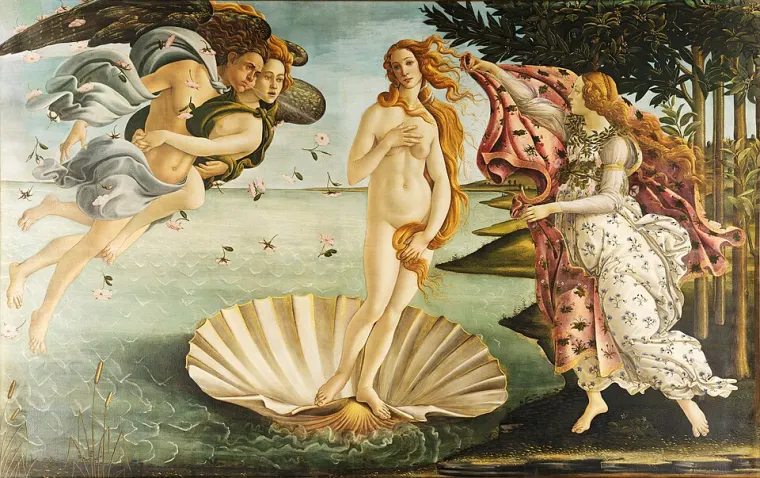
This is a useful limit for interpretation. A chicken may carry associations, but a confident one-to-one decoding can conceal uncertainty. The same discipline matters in The Birth of Venus, where familiar stories about patrons and models are separated from documented facts.
Three musketeers place several moments inside one image
The Night Watch is silent, yet it is easy to imagine its noise. Across the canvas, three guardsmen demonstrate different stages of handling a musket: loading, firing, and clearing the barrel after a shot. They are not successive images of one man. Rembrandt distributed successive actions among different bodies, allowing the viewer to experience several seconds while scanning a single surface.
The firing figure and his smoke are partly hidden behind the leaders, and wear has made some effects harder to see. A smaller seventeenth-century copy preserves details that are less legible on the original today. Comparison does not replace the painting, but it helps distinguish an intentional subtlety from a passage transformed by material history.
At the right edge, the drum adds another imagined sound. The dog below reacts, making an acoustic event visible without written explanation. The flag's movement, diagonal weapons, open mouths, marching feet, smoke, and animal response turn the group portrait into a network of causes. The precise sequence remains open, but asking what each figure hears keeps the eye moving through the crowd.
In 1715, the canvas was cut on all four sides to fit a new wall
The painting did not survive at its original dimensions. When it moved from the Kloveniersdoelen to Amsterdam Town Hall in 1715, strips were removed so it would fit between two doors. The largest loss was on the left. Those pieces of Rembrandt's canvas have not been recovered.
A small copy attributed to Gerrit Lundens, made between about 1642 and 1655, records the earlier composition. It includes a bridge, two additional guardsmen, and a child at left, as well as more space above the flag and along the right edge. Movement feels less compressed, and the officers no longer occupy almost the geometric center.
In 2021, the Operation Night Watch team reconstructed the missing zones from the copy and displayed panels around the original. Artificial intelligence helped translate information from the smaller copy toward Rembrandt's scale, color, and handling. It did not discover the missing paint, and the panels were not additions to the original canvas. The result was a research-based visualization of a lost composition, not a claim that the lost brushstrokes had been recovered.
The distinction changes interpretation. If we explain today's center as entirely Rembrandt's choice, we mistake a later physical intervention for an artistic decision. Historical works have at least two forms to consider: the object the artist completed and the object that reached us.
Operation Night Watch found decisions beneath the finished surface
Operation Night Watch began in 2019 and combines extremely high-resolution imaging with methods including macro X-ray fluorescence scanning and infrared reflectance imaging spectroscopy. Researchers detected a preparatory sketch made with a beige, chalk-rich paint beneath parts of the composition. That discovery allows the making of a very large painting to be studied nearly four centuries later.
Comparison between preparation and finished image revealed revisions: a feather was removed, a leg changed position, the number or placement of pikes was adjusted, and other details were reconsidered. The crowd was not transferred from a completely fixed blueprint. Rembrandt tested the density and rhythm of bodies and weapons on the canvas.
Scientific images also clarify why present appearance cannot always be equated with original intention. Wear around the dog exposes a light preparatory layer and softens its contour. Smalt, a blue glass pigment, has chemically altered in some areas. Varnishes and old retouchings changed too. Some darkness belongs to Rembrandt's dramatic design; some obscurity accumulated afterward.
Conservators are removing an older varnish under carefully controlled conditions. Varnish can saturate color and protect a surface, but it may yellow or lose transparency. Removing it does not send the painting untouched back to 1642. Pigment change, abrasion, earlier damage, and the missing edges are separate and sometimes irreversible. Research helps define which later layers can be treated and which surviving material must remain.
How to look at The Night Watch: follow movement before brightening the shadows
- Find the captain in black and trace his extended left hand
- Follow its shadow onto the yellow lieutenant and notice his forward step
- Move behind them to the small illuminated girl
- Scan from left to right for loading, firing smoke, and post-shot handling
- Find the drummer and dog, then imagine the competing sounds
- Follow the pikes and flag to establish the company's direction
- Picture the lost left edge and reconsider why the officers look centered
With a high-resolution image, begin zoomed out. If you brighten the shadows immediately, you may flatten the hierarchy Rembrandt built with light. Remember what you noticed first, then zoom into the girl, smoke, dog, textiles, and faces. Moving between whole and detail preserves both drama and evidence.
The painting remains compelling because its tensions cannot be reduced to one trick. It is a daylight portrait known by a nocturnal title, a record of real citizens animated by an emblematic girl, and a finished masterpiece that still carries cutting, fading, wear, and conservation. The more carefully those layers are separated, the more the picture behaves like a long event rather than a static icon.
For a desktop display, start with a museum collection record instead of a reposted search image, then check dimensions before cropping. The guide to rotating famous art on a Mac explains how to organize source images without losing track of what you downloaded.
Notice a different detail each time the painting returns
Art4 brings public-domain masterpieces to your Mac and lets you explore works by artist, movement, and theme without losing the collection context.
Primary collection and research sources
Keep a painting like this on your Mac
Art4 lets you browse public-domain paintings by artist, movement, color, and screen shape, read the story behind each one, and set it as your wallpaper, or let it rotate on its own. Try it free for 7 days; if you keep it, it’s a one-time $14. Requires macOS 14 or later, or Windows 10 or later.