
Bosch's Garden of Earthly Delights Explained: Panels and Hell
What does Bosch's Garden of Earthly Delights mean? Read the triptych in order, from the gray closed wings and Eden to the false paradise and the musical Hell.
The Garden of Earthly Delights is easy to misread as a catalogue of strange creatures. Bosch built it as a hinged triptych that tells a story in order. Closed, it shows a gray, unpeopled world on the third day of Creation. Opened, it runs from Eden through a bright garden of pleasure to a dark Hell, and the same things keep returning: owls, fountains, water, fruit. Follow that order before you zoom into any monster, and the painting stops looking random. This guide uses the Museo del Prado's catalogue and technical research, and it marks the places where interpretation becomes uncertain.
What does The Garden of Earthly Delights mean?
The short answer, in the reading of the Museo del Prado, is that the three inner panels are about sin: where it begins, how it is enjoyed, and how it is punished. The left panel shows Eden with Adam and Eve. The center panel shows a paradise that deceives the senses, a false paradise given over to lust. The right panel shows Hell, where every one of the cardinal sins receives its punishment. The Prado's catalogue also cites the Bosch scholar Reindert Falkenburg, for whom the overall theme is the fate of humanity.
That reading depends on treating the triptych as one sequence. If you look only at the center panel, which gave the work its name, you see crowds of naked people playing among giant fruit and birds with no visible violence. Some modern viewers have taken it as a carefree utopia. Read from left to right, though, the garden sits between the creation of the first couple and a Hell full of punishments, and its happiness starts to look provisional.
It is still worth separating levels of certainty. What we can see is a sequence of four images, three of them in color. What the Prado documents is the subject of each panel, the patron, and the changes Bosch made while painting. What remains interpretation is the precise meaning of hundreds of details. No statement by Bosch about this painting survives, so every symbolic key, including the ones in this guide, is a proposal tested against the picture.
Essential facts about the triptych
| Item | Details |
|---|---|
| Artist | Hieronymus Bosch (c. 1450–1516), active in 's-Hertogenbosch |
| Date | 1490–1500, according to the Prado; the date has long been debated |
| Medium | Oil on oak panel, with the outer wings in grisaille |
| Size | 185.8 cm high; center panel 172.5 cm wide; each wing 76.5 cm wide |
| Patron | Engelbert II of Nassau, according to the Prado catalogue |
| Collection | Museo del Prado, Madrid, on permanent loan from Patrimonio Nacional |
The object is large. Each panel is about 1.86 meters tall, and the opened triptych is more than three meters wide, so in the gallery the figures in the center panel are small and numerous, and you have to move along the work to read it. The format is the one used for church altarpieces, with a central panel and two hinged wings, but the Prado's catalogue concludes that its patron must have intended it for a palace rather than a church: the Nassau residence of Coudenberg in Brussels.
| View | Subject | What to look for |
|---|---|---|
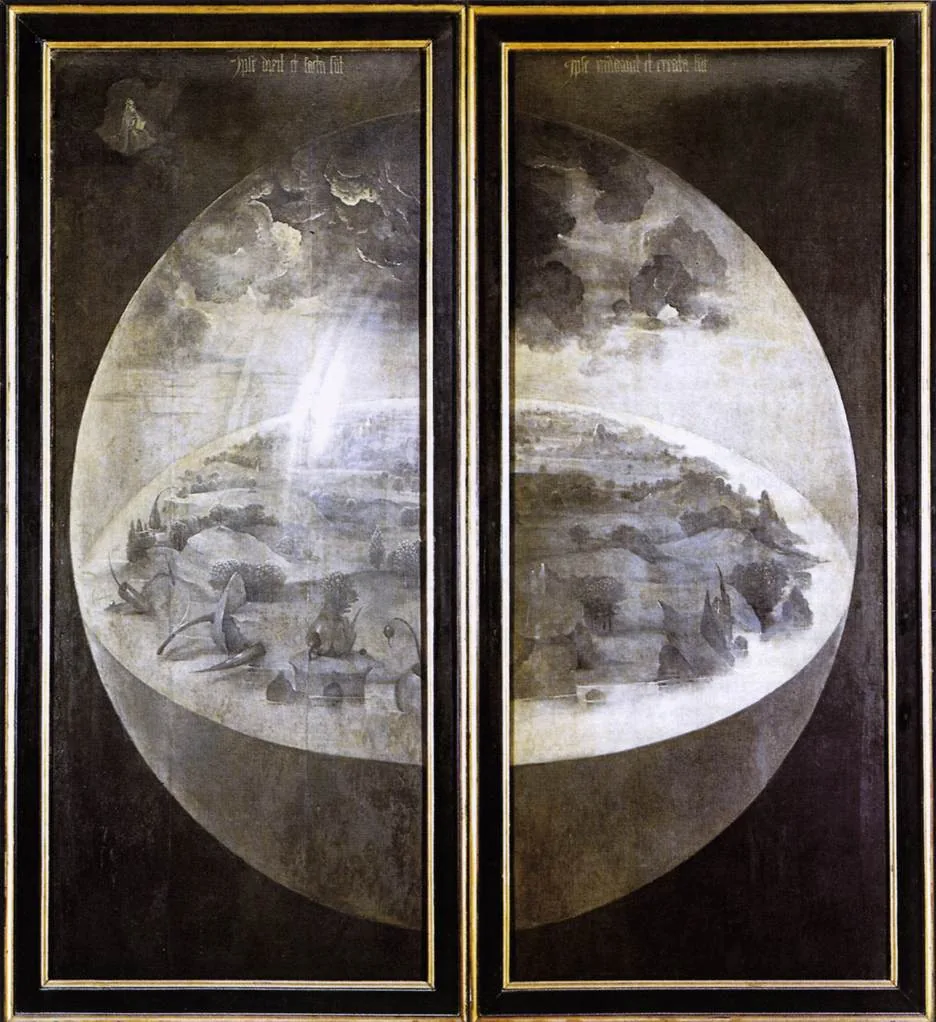
| Closed wings | The third day of Creation | A gray globe of land, water, and plants; a small God the Father at upper left |
| Left wing | Eden | God presents Eve to Adam below a tall pink fountain |
| Center panel | A garden of pleasure | Naked crowds, oversized fruit and birds, a cavalcade circling a pool |
| Right wing | Hell | Fire, ice, giant instruments, the bird-headed devourer, the Tree-Man |
Start with the wings closed: the third day of Creation
When the wings are shut, color disappears. Bosch painted the outer faces in grisaille, a technique in shades of gray. The Prado identifies the subject as the third day of Creation, when the waters were separated from the land and the earthly Paradise was made. A flat disk of land, with water and vegetation, floats inside a transparent sphere. There are plants, but no animals and no people yet. In Genesis the sun and moon are made only on the fourth day, which fits the dim light around the globe.
God the Father appears at the upper left, tiny beside the world he is making. Two Latin inscriptions, one on each wing, quote Psalms 33:9 and 148:5. In the King James wording the verses read "For he spake, and it was done" and "For he commanded, and they were created." According to the Prado, the image of God creating the world probably derives from a print by Michael Wolgemut in the Nuremberg Chronicle of 1493, which uses the same Psalm text. That borrowing matters for dating, as explained below.
Why begin here? Most reproductions show the triptych open, so the reveal is lost. Opening the wings takes you from gray to saturated red, blue, pink, and green, and from an empty world to a crowded one, in a single movement. The work is built on that contrast between a silent, newly made earth and what people go on to do with it.
Left panel: Eden is already uneasy
In the left wing, God stands between Adam and Eve and presents Eve to Adam, who sits on the grass. The Prado notes that this is a very uncommon subject and connects it to the institution of marriage. It was not Bosch's first plan. Technical study shows that he originally painted the Creation of Eve here and later replaced it. In the underdrawing, the three figures stood higher, in the middle of the scene, and God was bearded and turned toward Adam. In the finished panel God has the features of Christ and looks out at the viewer.
Behind them rises a tall pink fountain, which the Prado calls the fountain of the Four Rivers. In a round opening in the fountain, an owl looks out. The Prado's catalogue says that the owls in the center panel evoke evil. If that reading also applies here, the source of paradise already contains a watcher of ill omen.
Look around the edges and Eden is not entirely peaceful. A lion is killing its prey. Hybrid creatures emerge from the water in the foreground. A snake curls around a tree on the right. The Fall has not happened yet, but predation and temptation are already in the picture. That observation is visual; reading it as a warning of what follows is interpretation, though it fits the sequence the Prado describes.
Center panel: why the garden of delights is a false paradise
The center panel continues the landscape of Eden. The Prado points out that Bosch used one continuous landscape with a high horizon across the left and center panels, which makes the garden look like a natural extension of paradise. That continuity is part of the deception.
The foreground is crowded with naked men and women, Black and white, in pairs and groups whose erotic play points to the panel's main theme, the sin of lust. Animals, real and imaginary, are much larger than life, and so are the fruits. Red fruit and blue fruit are scattered everywhere and become the two dominant colors. Two owls of different kinds sit near the left and right edges, staring straight out at us. The exception to all this nakedness is a pair at the lower right, whom the Prado says are usually identified as Adam and Eve after the Expulsion.
Farther back, geometry takes over from the jumble. Women bathe in a round pool, and men ride around it counterclockwise on horses, camels, and imaginary mounts; some scholars have linked the riders to particular deadly sins. In the lake behind them stand five fantastic constructions. The central one resembles the fountain of Eden, but cracked. Where an owl sat inside the fountain in paradise, couples now take its place.
Fragility is the recurring idea. According to the Prado's exhibition text, a pair of lovers inside a glass sphere probably refers to a Flemish proverb: "Happiness is like glass, it soon breaks." In 1605 Fray José de Sigüenza, librarian of El Escorial, described the picture in terms of vain glory and the brief taste of the strawberry, a fruit that appears again and again. The giant fruits are sweet and short-lived at the same time.
The Prado's catalogue, following Paul Vandenbroeck, reads the panel as a false paradise of love: the figures believe they live in a garden for lovers, but their only destination is Hell. Whether every rider and every fruit carries a precise meaning is less certain. The panel is also so inventive that a picture meant as a warning gives real pleasure to look at, and that tension is part of why it holds attention.
Right panel: Bosch's Hell, where pleasures return as punishments
In the right wing the light goes out. Buildings burn in the background, and the foreground is dark, cold, and crowded with devils. The Prado calls it Bosch's most striking image of Hell. It is sometimes called the musical Hell because of the instruments used to torture people who gave their time to secular music. A man is stretched across the strings of a harp, a giant lute and a hurdy-gurdy become instruments of torture, and a large bagpipe, which the Prado's exhibition identified as a symbol of lust, sits on the head of the Tree-Man.
The center panel concentrated on lust. In Hell, according to the Prado's catalogue, all the cardinal sins are punished:
- Avarice. A bird-headed creature, which the Prado describes as a kind of owl, sits on what looks like a child's toilet chair, devouring sinners and expelling them at once.
- Gluttony. Inside the hollow body of the Tree-Man is a tavern where seated figures wait for devils to serve them toads and other creatures.
- Envy. Sinners are punished by immersion in frozen water.
- Games. Other punishments target vices censured at the time, including board games.
- The clergy. In the lower right corner, a pig wearing a nun's veil embraces a naked man.
Some details carry local meaning. A huge knife emerges from between two ears. The Prado's exhibition text notes that 's-Hertogenbosch had a flourishing knife-making industry and reads the ears as those deaf to the message of salvation. The same text suggests that Bosch's interest in fires may go back to the blaze that swept through 's-Hertogenbosch in 1463, when he was a boy; the museum presents this as likely rather than certain.
Comedy and horror work together here. The pig in a veil and the bird on a toilet chair are absurd, but absurdity does not soften the punishments. It keeps the eye moving from one torment to the next.
Is the Tree-Man a self-portrait of Bosch?
The Tree-Man dominates the center of Hell. His torso is a broken, hollow shell with the tavern inside. His legs are bare tree trunks that rest in small boats on the ice. On his head is a disk on which small figures circle the bagpipe, and his pale face turns back over his shoulder toward the viewer.
The Prado's 2016 Centenary Exhibition described the Tree-Man as probably a self-portrait of Bosch, pointing out our destiny to us. The key word is probably, and it should stay that way. No inscription or document identifies the face. Treat the self-portrait as a serious hypothesis, not a fact.
The motif also existed outside the painting. The same exhibition showed a pen-and-ink drawing of a Tree-Man from the Albertina in Vienna, dated about 1500 to 1510. Whatever the face represents, the figure is a good summary of the right panel: a body that has become a building, a container, and a landscape at once.
What infrared and X-ray images revealed
For the 2016 exhibition the Prado re-examined the triptych and displayed an infrared reflectogram and an X-radiograph beside it. These images show that the painting was planned, revised, and tightened rather than improvised in one pass.
The underdrawing was done freehand with a brush over the white ground. Faces are defined with very few strokes, sometimes just three lines for the eyes and nose. The biggest changes in the drawing are in Eden, where the group of God, Adam, and Eve was moved down and God's appearance and gaze were changed, and in the center panel, where Bosch reworked the couple in the cave at lower right, the rider who breaks the circle around the pool, and above all the false fountain of the Four Rivers in the background.
The X-radiograph shows changes made during painting. In the center panel Bosch removed a piece of fruit, possibly a pomegranate, at the lower left edge, altered part of the landscape on the right, and repeatedly reworked the face of the woman with two cherries on her head. In Hell he painted out several large objects and beasts, including an amphibian with a large sphere emerging from its body and a man inside it.
These findings change how the painting should be read. Bosch's strangeness was not a stream of free association. He edited it, removing elements that crowded the composition and adjusting the figures that carry the story.
Who commissioned it, when was it painted, and how did it reach Madrid?
The triptych is not signed, but the Prado notes that its attribution to Bosch has never been doubted. Its date has been. Before 2004 most authors placed it after 1505, late in Bosch's career. The results of tree-ring analysis of the oak panels would even permit an earlier date. The Prado now dates it to the 1490s for two reasons: its closeness in style to Bosch's Adoration of the Magi triptych, which can be dated to 1494 after its donors were identified in 2004, and the borrowing of the Creator from Wolgemut's print, published in 1493.
The earliest firm sighting comes from Antonio de Beatis, secretary to Cardinal Luis of Aragon, who recorded the triptych in the Nassau palace of Coudenberg in Brussels on 30 July 1517. With the earlier date, the Prado concludes that the patron was Engelbert II of Nassau, who died in 1504, rather than his nephew Henry III.
Its later history follows European politics. The painting passed from Engelbert's heirs to René de Châlon and then William of Orange, was confiscated in Brussels by the Duke of Alba in 1568, and was bought by Philip II of Spain in 1591. He sent it to the monastery of El Escorial in 1593. It moved to the Prado in 1933 and remains there on permanent loan from Patrimonio Nacional. The Prado also holds Velázquez's Las Meninas, another painting whose meaning depends on where the viewer stands and in what order things are seen.
Read the details as transformations, not a secret code
The Garden of Earthly Delights has more motifs than any key can explain. Instead of trying to decode each one, look for the things that change from panel to panel. Bosch repeats elements across the triptych and alters their character as the world moves from creation to punishment.
| Motif | Left: Eden | Center: the garden | Right: Hell |
|---|---|---|---|
| Owls | An owl looks out of an opening in the fountain | Two owls stare at the viewer from the left and right edges | The creature who devours sinners has an owl-like head |
| Fountains | The fountain of the Four Rivers stands intact | A similar fountain rises from the lake, but cracked | Burning buildings fill the background |
| Water | A clear pool in the foreground | A pool of bathers and a lake of strange constructions | Frozen water where the envious are punished |
| Food | Plants of a newly made garden | Giant strawberries and berries, red and blue | A tavern where devils serve toads to gluttons |
Read this way, the owls form a thread from the fountain of paradise to the garden's edges to the devourer of the avaricious. The fountain goes from whole to cracked, and its world ends in flames. Water goes from clear to icy. The painting turns out to be a system of variations rather than a pile of curiosities.
The same order of operations, observing first and interpreting second, works for very different art. The seven-minute method for looking at abstract art starts from visible relationships, and it transfers well to a picture this crowded: name what repeats, note where it changes, then ask what the change might mean.
How to look at The Garden of Earthly Delights in order
- Start with the closed wings: find the small God at upper left and the globe with no people or animals.
- Open the triptych and look at all three panels at small size, following the horizon from Eden into the garden.
- Track where the colors darken as you move from left to right.
- In Eden, find the owl in the fountain; in the center, find the two owls at the edges; in Hell, find the bird-headed devourer.
- Compare the circular cavalcade in the center with the scattered, falling movement of Hell.
- Choose one motif, such as fruit, water, or a fountain, and look for it in every panel.
- Finish at the Tree-Man, then step back to see where he sits in the whole composition.
This painting rewards a wide view. Cropping one monster for a desktop loses the sequence that gives it meaning. If you use the triptych as a wallpaper, the MacBook wallpaper resolution guide explains why a very wide image gets clipped on a MacBook screen and how to keep its full width. With three displays, a triptych invites you to give each panel its own screen; the guide to setting a different wallpaper on each monitor covers how macOS assigns images per display.
Zoom into the details, then return to the whole
Art4 brings public-domain masterpieces to your Mac in high resolution and lets you explore works by artist, movement, and theme, with the artwork information kept beside the image.
Primary sources
Keep a painting like this on your Mac
Art4 lets you browse public-domain paintings by artist, movement, color, and screen shape, read the story behind each one, and set it as your wallpaper, or let it rotate on its own. Try it free for 7 days; if you keep it, it’s a one-time $14. Requires macOS 14 or later, or Windows 10 or later.