
Girl with a Pearl Earring Explained: What Research Revealed
Who is the Girl with a Pearl Earring? Mauritshuis research explains the tronie, the painted pearl, the faded green curtain, eyelashes, and revisions.
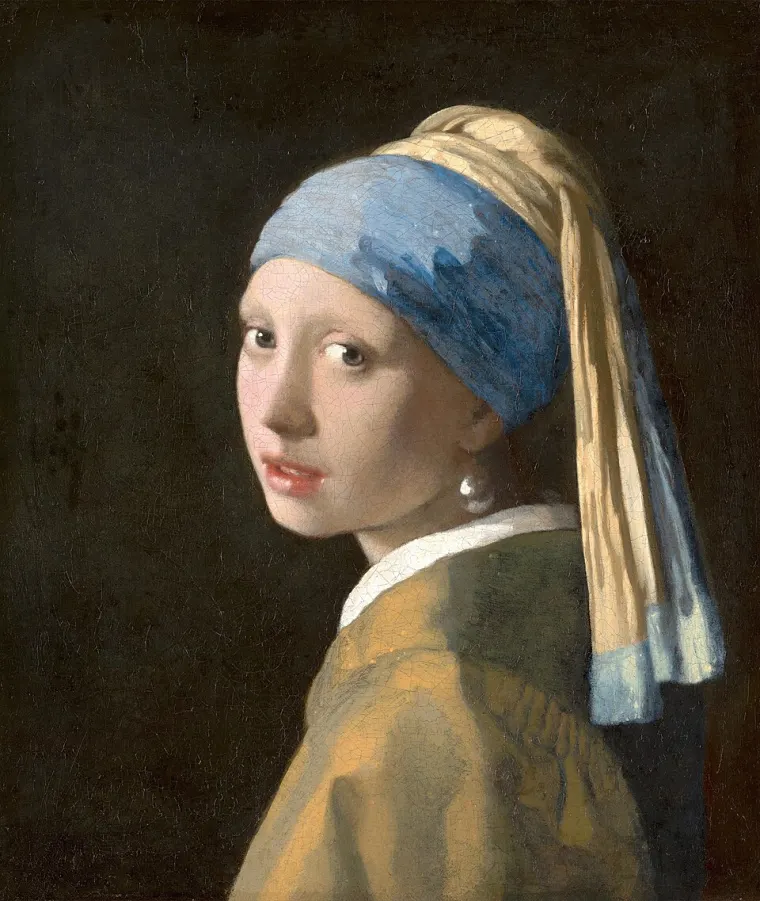
The painting’s force comes from precise omission, not abundant detail. The pearl has no contour or visible hook; two pale reflections make it present. The boundary between nose and cheek disappears, leaving the viewer to complete the form. Scientific examination has shown that this economical surface once included a green curtain, fine eyelashes, and several revisions.
Essential facts about Girl with a Pearl Earring
| Item | Detail |
|---|---|
| Artist | Johannes Vermeer |
| Date | c. 1665 |
| Medium | Oil on canvas |
| Dimensions | 44.5 × 39 cm |
| Collection | Mauritshuis, The Hague |
| Type | A tronie—a study of a character or expression, not an identified sitter’s portrait |
The painting belongs to the Mauritshuis in The Hague. No document identifies the girl, a patron, or the exact circumstances of the commission. “The Mona Lisa of the North” and the narratives supplied by modern novels and films belong to the work’s later reception.
To understand the painting, separate those compelling stories from the seventeenth-century category and from facts established by material research.
Who is the girl? The work is a tronie, not a conventional portrait
The Mauritshuis classifies the picture as a tronie. In the Dutch seventeenth century, a tronie was an independent study of a face, expression, age, costume, or character type. It did not primarily record a patron’s identity and status.
The exotic headscarf, oversized jewel, and dark setting create a study in color and light rather than a documentary account of everyday dress. A real sitter may well have posed, but there is no evidence that identifies her as Vermeer’s daughter, a servant, or a patron’s relative.
An unknown identity is not a missing answer that research must eventually fill. Because the work is not an identified portrait, the turn of the head can remain suspended between events and invite the viewer to imagine what preceded it.
The pearl is made from a few strokes and the viewer’s eye
Look closely and the earring loses the solid boundary expected of a spherical object. A bright upper highlight and a softer reflection below imply a glossy volume. The dark ground supplies the missing edge, and no hook visibly joins the object to the ear.
The Mauritshuis notes that the jewel may be too large to be a natural pearl and could represent polished metal or glass. The title names the effect the painting gives us; it does not constitute a gemological test.
The point is Vermeer’s economy. He painted the visual conditions under which an object reads as reflective and round, then allowed perception to finish it.
The black background was once a green curtain
Today the figure seems to emerge from an empty black field. Technical imaging found evidence of a translucent green curtain with diagonal folds behind her. Changes in pigments and binding media over centuries caused that spatial layer to darken and flatten.
This matters compositionally. The original viewer encountered a subtly differentiated backdrop, not absolute void. The work has become more mysterious partly because its materials aged.
Material change should not be confused with an artist’s revision. Vermeer chose a curtain; time changed how it appears.
Scientific research revealed a planned sequence and revisions
| Area | Finding |
|---|---|
| Background | Now appears black; originally a dark green curtain with diagonal folds |
| Eyes | Fine eyelashes, difficult to see with the naked eye, were painted around both eyes |
| Pearl | Translucent and opaque white highlights; no hook connecting it to the ear |
| Underpainting | Broad brown and black strokes established light and dark before details |
| Revisions | Vermeer adjusted the ear, upper edge of the headscarf, and back of the neck |
Imaging shows that Vermeer began with broad areas of brown and black to establish the light-dark structure. He then developed color and edges, adjusting the ear, headscarf, and neck along the way.
These corrections matter because the final image can appear effortless and instantaneous. It was achieved through decisions: where an edge should remain sharp, where it should dissolve, and how far the head should turn.
Why is it difficult to look away?
The girl turns toward us while her body continues away. Her lips part, the eyes catch separate highlights, and the headscarf leads the face into the dark. This combines arrival and departure in one pose.
The Mauritshuis has also reported research into the painting’s ability to hold visual attention. That finding should not be turned into a mystical formula. Several observable devices work together: high contrast around the eyes and mouth, unresolved narrative, softened transitions, and the luminous earring below the face.
The face is not uniformly detailed. Sharp highlights provide anchors, while absent contours make the gaze continue searching.
A sequence for looking at Girl with a Pearl Earring
- Cover the earring mentally and notice how the balance changes
- Compare the sharp eye highlights with the disappearing nose-cheek boundary
- Trace the blue and yellow headscarf as one large shape
- Look for the nearly invisible connection—or lack of one—between ear and jewel
- Imagine the original green curtain without treating the present surface as defective
- Step back and decide which marks your eye completes on Vermeer’s behalf
For another work where material evidence corrects a familiar story, read The Kiss by Gustav Klimt explained. To practice describing color, edge, and shape before assigning a subject, use the seven-minute method for looking at abstract art.
Primary research and collection records
Keep a painting like this on your Mac
Art4 lets you browse public-domain paintings by artist, movement, color, and screen shape, read the story behind each one, and set it as your wallpaper, or let it rotate on its own. Try it free for 7 days; if you keep it, it’s a one-time $14. Requires macOS 14 or later, or Windows 10 or later.