

Dance at the Moulin de la Galette Explained: Renoir's Sunday Crowd
Explore Renoir's Dance at the Moulin de la Galette through the real Montmartre dance garden, the friends identified as models, the dappled light on clothes, and the split reviews of 1877.
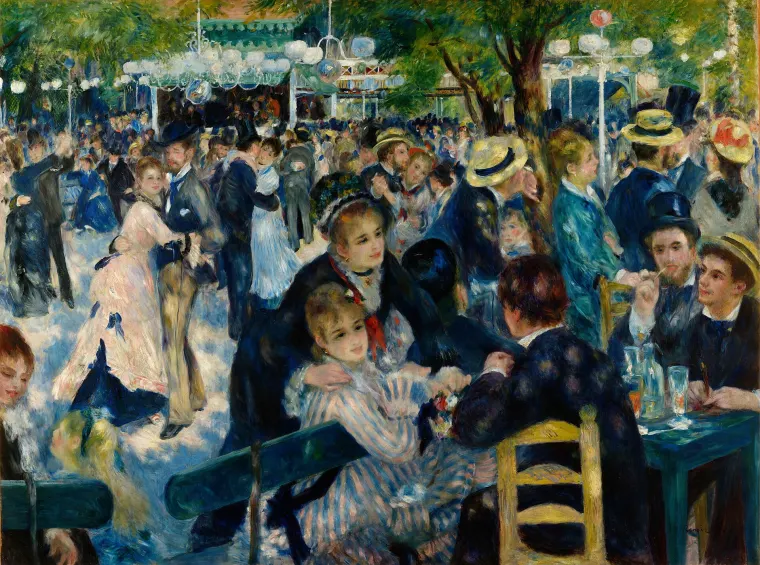
Dance at the Moulin de la Galette is not an invented festival with an anonymous crowd. Renoir painted a real Sunday dance garden in Montmartre and filled it with people he actually knew: painter friends, a young critic, and working-class girls from the neighborhood. Round, soft-edged patches of light drift across their jackets and the ground. Some critics in 1877 read those patches as confusion; they are afternoon sunlight falling through acacia leaves, and they are the painting's real subject. Once you know who is there and what the light is doing, a dancing afternoon from 150 years ago becomes remarkably concrete.
Key facts about Dance at the Moulin de la Galette
| Item | Detail |
|---|---|
| Date | 1876, painted largely on site in spring and summer, likely finished in the studio |
| Medium | Oil on canvas |
| Dimensions | 131.5 × 176.5 cm |
| Subject location | The Moulin de la Galette dance garden on the Butte Montmartre, Paris |
| Collection | Musée d'Orsay, Paris (Gustave Caillebotte bequest, accepted 1896) |
At 176.5 cm wide, this is an unusually large canvas for an outdoor crowd scene of its time. The Musée d'Orsay describes the imposing format itself as a sign of Renoir's ambition: he gave a popular working-class amusement the physical scale that official painting reserved for history subjects. The picture was shown at the third Impressionist exhibition in 1877, passed into the collection of the painter Gustave Caillebotte, and entered the French national collections through his bequest, accepted in 1896.
The painting therefore traces the arc of Impressionism in a single object: publicly debated the year after it was finished, protected inside a fellow painter's collection, and finally installed as a centerpiece of a national museum.
The Moulin de la Galette was a real windmill dance garden
The moulin in the title means windmill. Two old mills, the Radet and the Blute-Fin, still stood on the Butte Montmartre in the nineteenth century, and an entertainment garden had operated around them since 1834. According to the Musée d'Orsay, the establishment in the 1870s belonged to Pierre-Auguste Debray, a miller's son, and held a ball with food service every Sunday from the afternoon until midnight.
Visitors entered from the rue Lepic, passed a first courtyard, and reached a wooden dance hall rebuilt in 1873, which opened onto a second courtyard planted with acacias and furnished with benches and games. A small orchestra played on a platform, and for ten centimes a staircase led up to the Blute-Fin mill and a panorama over Paris. Renoir painted this outdoor courtyard, not the indoor hall.
The museum describes the regulars as Montmartre locals: working families, clerks, students, with artists mixing among them. This was not a glamorous society ball near the Champs-Élysées but an inexpensive neighborhood pleasure. The painting's first quiet provocation is that it grants this ordinary weekend crowd a canvas worthy of a Salon history picture.
The dancers are documented friends and neighborhood girls
| Figure | Position | What is recorded |
|---|---|---|
| Jeanne and Estelle | Foreground bench, striped dress | Sisters; Jeanne is recorded as a sixteen-year-old seamstress |
| Georges Rivière | Table at the right | Young critic; later wrote the memoir Renoir et ses amis |
| Franc-Lamy and Norbert Goeneutte | Around the table | Painters; Goeneutte also appears in The Swing |
| Margot (Henriette-Anna Leboeuf) | Dancing couple at left | Model Renoir painted repeatedly between 1875 and 1879 |
| Solares y Cardenas | Margot's tall dance partner | A painter from Cuba |
The crowd is not imaginary. Renoir's friend Georges Rivière, a young critic, left written recollections that allow the Musée d'Orsay to identify the main figures. On the foreground bench sit Jeanne, a sixteen-year-old seamstress, and her sister Estelle. At the table are the painters Franc-Lamy and Norbert Goeneutte together with Rivière himself. The couple dancing at the left pairs Margot, a model Renoir painted often, with the Cuban painter Solares y Cardenas.
The museum stresses that Renoir hired no professional models for this picture. He posed his artist friends and young Montmartre working women, whom he paid for their time. The painters Henri Gervex and Samuel Cordey are also recorded as participants, though they cannot be pinned to specific figures. And the museum notes one more thing worth keeping: no romantic relationship between these sitters is documented. The scene invites stories, but what the evidence supports is simpler and stranger—a group of friends assembling a dance, afternoon after afternoon, so that a painting could happen.
Separating what documents establish from what the image suggests is the same habit we recommend in our evidence-first method for looking at abstract art; it keeps a famous picture from collapsing into anecdote.
Painted on site, finished in the studio
The Musée d'Orsay states that the canvas was painted mostly on location in the spring and summer of 1876 and probably completed during the autumn and winter in Renoir's studio, first on the rue Cortot and then on the rue Saint-Georges. Renoir was renting the Cortot studio within walking distance of the dance garden; the picture grew out of a place he could visit constantly.
An earlier oil sketch of 1875–76 survives and shows a first idea for the composition, with more prominence given to the dance-hall architecture and to spatial markers such as trees and lampposts. In the finished painting Renoir raised the horizon line high and let foliage screen the buildings, so an organized establishment reads instead as a leafy open-air party. He also chose a slightly elevated viewpoint, painting from the steps, which opens the dance floor behind the foreground group and lets the crowd stack up row after row.
The lesson is easy to miss: a picture that feels like a snapshot of a single instant is in fact a constructed image, with viewpoint, horizon, and vegetation all deliberately arranged. Impressionism was never simply fast, unplanned painting.
The round patches are sunlight through acacia leaves
The most argued-over feature of the painting is the scatter of soft, bright spots across hats, jackets, and the ground. The Musée d'Orsay explains them as light filtered by the acacias and diffused over people and objects in colored patches of pink and orange. They are not careless brushwork; they are what dappled light actually does to figures under trees.
Renoir's handling fuses with this light. The museum describes a palette unified by a dominant blue-mauve tone and a technique in which almost nothing is separated by a firm contour. Even foreground faces and the bouquet on the bench are suggested by touches of color rather than enclosed by drawn edges. Because no outline seals the forms, the light patches can travel freely across bodies and ground.
Follow the boundary between shade and sun and the space of the picture organizes itself. The foreground tables sit in blue-violet shadow under the trees; sunlight breaks onto the dance floor beyond, switching shoulders and gravel into brightness. The eye keeps crossing between a shaded conversation zone and a sunlit dancing zone, and that movement is what makes the canvas feel loud with music.
The crowd is built in three layers
The Musée d'Orsay reads the composition in three planes. In the background, figures shrink until faces dissolve and only the effect of a crowd remains. In the middle distance at the left, couples dance, caught mid-movement. In the right foreground, a group of about ten people around the bench and table are linked to one another by glances and gestures.
One blue-mauve tonality and one system of dappled light cover all three layers, so the eye slides from the nearest conversation into the deepest murmur without a seam. Three tempos of the same afternoon—talking, dancing, and distant buzz—run simultaneously in a single frame.
The construction stands out sharply if you compare the other great weekend-leisure crowd of the period, Seurat's Sunday on La Grande Jatte, painted a decade later with frozen, hard-edged figures. Renoir made the opposite choice: dissolve every contour and keep everyone mid-motion. Two masterpieces share one modern subject and disagree about almost everything else, which is exactly why the comparison teaches so much about how Impressionism differs from what followed it.
In 1877 the same canvas was called confusion and life
The painting appeared at the third Impressionist exhibition in the spring of 1877 on the rue Le Peletier. The reviews the Musée d'Orsay quotes pull in opposite directions. Hostile critics attacked a confusion of appearance and a search for bizarre tonalities: to them, the dappled patches and missing contours looked like an abandoned finish.
Others saw the point. Émile Zola credited the picture with an extraordinary intensity of life in April 1877, and another reviewer praised how exactly it captured the rowdy, slightly disheveled atmosphere of this kind of popular dance garden. The most famous verdict came from Renoir's friend Rivière, writing for the exhibition: noise, laughter, movement, sun, an atmosphere of youth—a page of history, a precious monument of Parisian life.
Notice that both sides described the same features. The question was whether dissolved contours and traveling light were a defect of craft or a new way of recording a modern weekend. The disagreement was not about whether the painting succeeded on the old terms; it was about whether the old terms still applied.
One title, several related canvases
More than one painting answers to this subject. First, the surviving oil sketch of 1875–76 preserves the earlier idea of the composition, with its more legible architecture; the Musée d'Orsay's own analysis presents it alongside the finished work. Second, a smaller version of the finished composition exists in a private collection. Its sale at auction in 1990 made international headlines and enlarged the painting's fame, but scholars still disagree about whether the small canvas prepared the large one or repeated it afterward. Any account that states the order as settled fact is offering an interpretation.
Third, in the same summer of 1876 Renoir painted The Swing in the same Montmartre garden; it now also hangs in the Musée d'Orsay. It tests the same problem—colored light falling through leaves—on a scene of just a few figures, and the painter Goeneutte appears in both pictures. Seen together, the two canvases show how single-mindedly Renoir pursued light under trees in that one year.
Keeping the versions straight matters for a practical reason: reproductions circulate from more than one canvas, and small differences in framing and finish are easy to misread as printing errors rather than as different paintings.
A viewing sequence for Dance at the Moulin de la Galette
- Start with the foreground bench and find the sisters in the striped dress facing you
- Follow the glances of the men at the table and see whom each one addresses
- Move left to the dancing couple, Margot spinning her tall partner
- Count the round light patches on clothing and ground, and sense the canopy above
- Confirm how high the horizon sits—almost at the top edge
- Push your eye to the deepest rows, where faces dissolve into crowd
- Step back and weigh the two zones against each other: blue-violet shade and sunlit floor
In a small thumbnail this painting flattens into a generic busy crowd. At full width it is a layered space of conversation, dance, and distant noise. On a display, keep the left dancers and the deep crowd in frame rather than cropping to the foreground table alone; the three layers are the picture. For how resolution and cropping interact on a laptop screen, see our MacBook wallpaper resolution guide.
Keep this dappled afternoon on your desktop
Art4 brings Dance at the Moulin de la Galette and other public-domain masterpieces to your Mac as rotating wallpapers, with artwork context always one click away.
Sources and further reading
Keep a painting like this on your Mac
Art4 lets you browse public-domain paintings by artist, movement, color, and screen shape, read the story behind each one, and set it as your wallpaper, or let it rotate on its own. Try it free for 7 days; if you keep it, it’s a one-time $14. Requires macOS 14 or later.