
Why Is There a Skull in Holbein's The Ambassadors?
Where is the skull in Holbein's The Ambassadors, why is it stretched, and where do you stand to see it? What the National Gallery documents and what's debated.
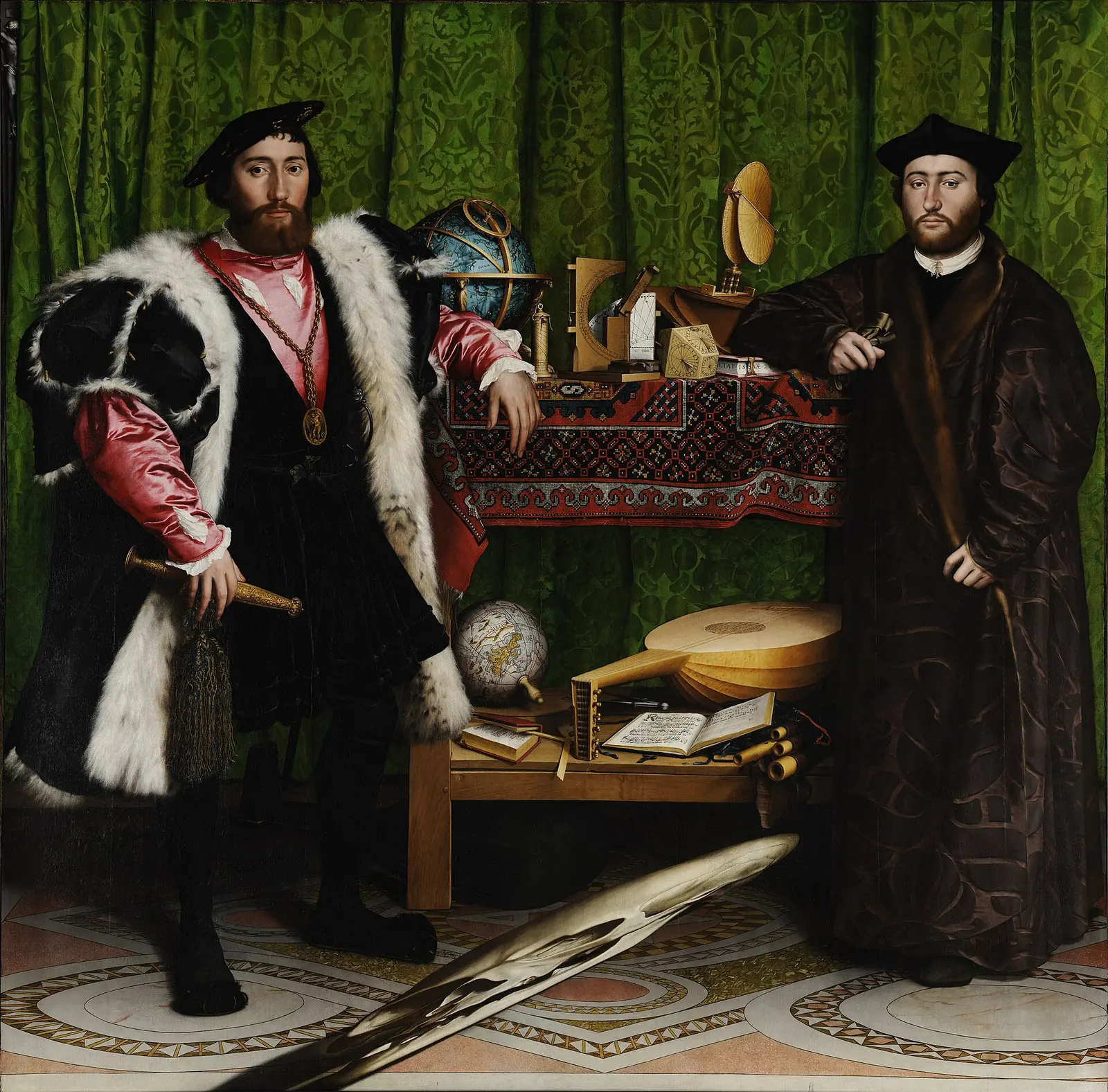
Stand in front of Holbein's The Ambassadors and you see two well-dressed Frenchmen, a cabinet crowded with globes and instruments, and a pale, slanting shape on the floor that refuses to become anything. Walk to the right edge of the painting, lower your eyes toward the wall, and the shape snaps into a human skull. That trick is the reason most people search for this picture. This guide answers the practical questions first: where the skull is, why it is distorted, and where to stand. Then it looks at what surrounds it, and keeps a clear line between what the National Gallery documents and what is still argued over.
The short answer: a skull painted for a sideways glance
The skull lies on the floor in the lower part of the painting, between the two men. The National Gallery describes it as a distorted, elongated object that appears to hover between their feet. It is the long grey-white form that runs diagonally from near the bottom left edge up toward the right, in front of the lower shelf. From the front it reads as a smear, a plank, or a piece of bone that has been pulled like toffee.
Here is the answer in three parts:
- What it is. A human skull. The National Gallery calls the effect anamorphosis: a distorted perspective that resolves only when seen from the side.
- Why it is there. The Gallery calls it a memento mori, a reminder of death and of the frailty of life, and notes that it also advertises Holbein's skill.
- How to see it. According to the Gallery, the skull can only be seen properly if you look up at the painting from the bottom right corner.
It is worth knowing that the skull has not always been obvious to viewers. The Gallery's 2024 catalogue notes that when the painting was in England in the nineteenth century, it was not immediately apparent that it contained a distorted skull. One writer of the period described the shape as a singular object that looked like "the bones of some fish." Yet a Paris sale catalogue of 1787 had already described it as a skull painted in perspective. The image works on whoever knows to look for it, and quietly fails on whoever does not.
The painting at a glance
| Item | Details |
|---|---|
| Museum title | Jean de Dinteville and Georges de Selve ('The Ambassadors') |
| Artist | Hans Holbein the Younger (1497/8-1543) |
| Date | 1533, signed and dated on the floor at lower left |
| Medium | Oil on oak, ten vertical boards |
| Size | 207 × 209.5 cm (height × width) |
| Collection | National Gallery, London (NG1314), bought 1890 |
"The Ambassadors" is a nickname. The museum title simply names the two sitters: Jean de Dinteville and Georges de Selve. At 207 by 209.5 centimeters, the panel is a fraction wider than it is tall, which makes it very nearly square. Both men are shown full length and close to life size.
The support is built from ten vertically grained oak boards, and tree-ring dating places the timber in the Baltic-Polish region. Martin Wyld's 1998 restoration report describes the work as Holbein's largest surviving panel painting that is entirely by his own hand.
Holbein signed it in the shadowed floor at lower left, in Latin, with the date 1533 beneath. Dinteville commissioned it and took it home to his chateau at Polisy in France, where an inventory of January 1589 records it. The painting was sold in Paris in 1787, reached the Earls of Radnor at Longford Castle in England early in the nineteenth century, and was bought by the National Gallery in 1890.
How anamorphosis works
Ordinary perspective assumes a viewer standing in front of the picture. Anamorphosis moves that imagined eye far to the side, almost level with the picture surface. From such a shallow angle, anything on the surface looks drastically compressed. So the painter stretches the image in advance, by just the amount the angle will squeeze it back.
You have probably seen the same principle on the street. Words painted on road surfaces, such as SLOW or BUS ONLY, look absurdly tall when you stand over them, and normal from a driver's seat. Holbein's skull is too long from the front and correct from the side for the same reason.
The National Gallery's catalogue points out that this kind of distortion occurs nowhere else in Holbein's work. It was not, however, unusual in the sixteenth century, and seems to have been somewhat fashionable. The German printmaker Erhard Schön, for example, made anamorphic woodcut portraits of the Emperor Charles V and his brother Ferdinand. The catalogue also suggests that Dinteville may have known of Leonardo da Vinci's anamorphic experiments from the French court, and that Selve could conceivably have seen anamorphic images by Schön or other German artists at Speyer in 1529. Those are possibilities the catalogue raises, not documented events.
How exactly Holbein constructed the skull is also unsettled. The catalogue discusses several possible methods, from grids to projection, without committing to one. What it does state plainly is that no artificial viewing device is involved. You do not need a mirror or a glass cylinder. You only need to move.
Where to stand to see the skull
The National Gallery's own guidance is short: look up at the painting from the bottom right corner. The audio description on the same page says the shape reveals itself as a skull only when viewed from close to the right of the painting.
The 2024 catalogue gets precise. It describes an optimum viewing point to the right of the picture, about 12 centimeters out from the wall surface, 10.4 centimeters from the bottom of the picture, and some 79 centimeters from its right edge. You do not have to hit that exact point. The catalogue explains that the skull can be seen properly from a range of positions along a line joining the center of the skull to that optimum point, and that it resolves more easily from the right than from the left.
In the gallery, that translates into a simple routine. Walk to the right-hand edge of the painting, bring your face close to the wall, and look back along the surface toward the skull. Because the ideal eye height is close to the bottom edge of the panel, you may need to bend your knees, depending on how high it hangs. When the skull comes together, notice what happens to everything else: the two men and the cabinet collapse into steep slivers. You cannot see the skull and the ambassadors correctly from the same spot.
You can try a version of this at home. Open the image on your phone, put your eye near the lower right edge of the screen, and look along the glass toward the skull. The long shape shortens until the eye socket and the dome of the cranium appear.
The idea that a viewer's physical position completes a painting is not unique to Holbein. In Las Meninas, Velázquez uses a mirror to place the king and queen where the viewer stands. Holbein does something stranger: he makes the viewer walk away from the sitters to find the picture's most important image.
The doorway story: what is documented and what is assumed
Many explanations repeat a vivid story. The painting, it is said, hung beside a doorway or at the foot of a staircase, so that a guest leaving the room would glance back and suddenly meet a grinning skull. Even an older National Gallery teachers' note says it is likely that the picture was positioned beside a doorway.
The documentary record is much thinner. The key document is the inventory of January 1589, which places the painting in the great hall above the courtyard of the old building at the Dinteville chateau of Polisy. That is all it says about the setting. The 2024 catalogue notes that it is impossible to be certain whether that hall was the room where the painting was originally placed. It suggests that a room with doors to the right and left of the painting would have made the skull easier to view, but presents this as a conceivable arrangement, not a recorded one. The staircase idea it rejects outright: a spiral staircase would have made a difficult viewing place and an impossible hanging place.
Martin Wyld's restoration report is blunter still. Little is known of the original display at Polisy, he writes, "and nothing of Holbein's own intentions."
None of this makes the doorway story impossible. It simply moves it from the column of facts to the column of plausible guesses, which is where a careful description of the painting should keep it.
Who the two ambassadors were
On the left stands Jean de Dinteville (1504-1555), lord of Polisy and ambassador of King Francis I of France. The National Gallery describes 1533 as his second diplomatic mission to England, and notes that he was required to stay in London for the coronation of Anne Boleyn that June. According to the catalogue, he probably returned to France in November 1533, at the end of his posting. He was the man who commissioned the painting.
On the right is his close friend Georges de Selve, Bishop of Lavaur. The Gallery says Selve was also on a diplomatic mission, though its exact nature is unknown. Two letters from Dinteville to his brother, dated 23 May and 4 June 1533, mention a secret visit Selve paid him in London in April. The catalogue considers that visit likely to have inspired the commission, and the Gallery describes the portrait as a record of the friendship and of the brief time the two men spent together in England.
Their ages are written into the picture. The golden sheath of Dinteville's dagger is inscribed "AET. SVAE 29," and the book under Selve's arm reads "AETATIS SVAE 25." The catalogue translates these as his twenty-ninth and twenty-fifth year, which is why the Gallery's main text gives their ages as 28 and 24, while the audio description on the same page uses 29 and 25.
Their names were not always known. Before 1900, various other identities were proposed for the sitters, Thomas Wyatt among them. The question was settled when the historian Mary Hervey published three seventeenth-century documents naming the two men.
The clothes set them apart. Dinteville wears pink satin, a coat lined with lynx fur, and the medallion of the French royal Order of Saint Michael. Look at his black hat: it carries a small skull badge, a second skull in the painting that is easy to overlook. The catalogue notes there is no evidence that Dinteville used a skull as a personal device, and that such badges were not uncommon at the time. Selve wears a long, dark, fur-lined gown that the Gallery's teaching notes read as a cleric's more modest dress.
What is on the two shelves
Between the men stands a two-tier stand. The National Gallery describes the upper shelf as holding instruments used to measure time, altitude, and the position of the stars, and the lower shelf as holding objects tied to more earthly pursuits: music, learning, and the world itself. A patterned rug covers the top.
| Object | Where it is | What can be said about it |
|---|---|---|
| Celestial globe | Upper shelf, left | A globe of the heavens, mapped with constellations |
| Cylindrical pillar dial | Upper shelf, beside the celestial globe | A portable sundial that reads time from the date |
| Polyhedral sundial | Upper shelf, center right | A many-faced sundial |
| Book with Selve's age | Upper shelf, under Selve's elbow | Its edge records his age |
| Terrestrial globe | Lower shelf, left | Names Polisy, Dinteville's estate |
| Arithmetic book and set square | Lower shelf, left front | Peter Apian's merchants' arithmetic, open at division |
| Lute | Lower shelf, center right | One string is broken; its case lies face down on the floor |
| Case of flutes | Lower shelf, far right | One flute appears to be missing |
| Hymn book | Lower shelf, in front of the lute | A Lutheran hymnal open at two hymns in Luther's versions |
Several details reward a closer look. The terrestrial globe includes the name of Polisy, Dinteville's estate, which the catalogue uses to confirm that he is the man on the left. Oddly, Polisy is shown to the north-east of Paris rather than to the south-east, where it actually lies.
The arithmetic book is Peter Apian's guide to merchants' calculation, first published at Ingolstadt in 1527. A set square holds it open at a page beginning with the German word for "let division be made." A pair of dividers lies close by.
On the right, the lute has a single broken string, and its case lies face down on the floor. One flute appears to be missing from the case beside it. The open hymn book in front of the lute is based on Johann Walther's Lutheran hymnal, first published in Wittenberg in 1524; the catalogue says Holbein worked from the 1525 edition. The two hymns on display, Come Holy Ghost and the Ten Commandments, are Luther's versions, and they do not appear on consecutive pages in the original book. Holbein, in other words, selected them and placed them side by side.
The instruments on the top shelf closely resemble several in Holbein's 1528 portrait of the astronomer Nikolaus Kratzer. Whether they are painted accurately enough to be read like real instruments is another question, taken up below.
The crucifix behind the curtain
Look at the extreme top left corner. The green damask curtain is drawn back a little there, and in the gap hangs a small silver crucifix, cut by the edge of the panel. The National Gallery calls it equally hidden, setting it alongside the skull.
The catalogue observes that the crucifix is hung at right angles and in darkness, so that, like the skull, it is deliberately difficult to discern. The paint of the crucifix lies on top of the paint of the curtain, which suggests it may have been a late addition. Its Christ figure has been compared with the crucified Christ in Holbein's Passion altarpiece in Basel.
On meaning, the Gallery's page is cautious: the crucifix might hint at Christian unity, because it expresses the universal hope of salvation through Christ's sacrifice. The catalogue is more direct, stating that the counter to death, symbolized by the skull, was resurrection, and that the crucifix is placed in the top left-hand corner to that end. The two least conspicuous things in the painting, one stretched across the floor and one half out of the frame, carry its largest subject between them.
Why 1533 matters
The date is not incidental. The National Gallery sets the painting against a period of religious upheaval: Henry VIII would soon break with the Roman Catholic Church, because the pope would not annul his marriage to Catherine of Aragon. Dinteville stayed in London that year for the coronation of Henry's new queen, Anne Boleyn.
Across Europe, the Lutheran Reformation had already divided Christendom. In 1529 Selve had written an appeal urging the German nation to leave its differences behind and reunite Christendom. The catalogue weighs the carefully selected Lutheran hymnal against that background.
Even the floor has a possible London connection. According to the catalogue, its geometric pattern resembles, but is not identical to, the sanctuary pavement of Westminster Abbey, laid in 1268 and used as the setting for the consecration of English kings.
With that context in mind, many readers see the shelves as a picture of discord: a broken string, a missing flute, a book open at division. The Gallery's own overview says the array of objects seems to allude to discord. The word "seems" matters. No document from Dinteville or Holbein explains what any single object was meant to signify, so these readings are interpretations built on context, not decoded instructions.
Where readings part ways
The Ambassadors attracts puzzle-solving. Here are the main points where the National Gallery's catalogue takes a more cautious line than popular explanations.
A Good Friday date. The historian of astronomy John North argued that the pillar dial is set to 11 April, which was Good Friday in 1533, and built a wider reading of the painting around that date. The Gallery's older teachers' notes also mention 11 April in the morning. The 2024 catalogue is skeptical: the dial cannot distinguish dates in early April from mid-August, or morning from afternoon, and a separate calculation based on the celestial globe gives a different date, 10 July at around 2.40 pm. Its conclusion is that the instruments cannot support references to specific dates or times, and do not appear to relate to what little is known of Selve's visit.
Faulty instruments. The art historian Jeanne Nuechterlein has argued that the inaccuracies in the instruments are specific, considered, and deliberate. The catalogue also records that the celestial globe is set to about 42 degrees north, the latitude of Rome. Whether such features are slips or messages is still argued.
Viewing devices. Some accounts claim the skull was meant to be seen in a glass cylinder or curved mirror. The catalogue notes that the cylinder method is not documented in the sixteenth century, and its own position is that no device is needed.
A partly reconstructed skull. This one is documented, and it changes what you are looking at. Wyld's 1998 report records old losses in the skull. In 1891 a restorer repainted it, and the Gallery's conservators later judged that reconstruction "highly speculative and inaccurate," and found it covered some of Holbein's own paint. During the treatment completed in 1996, most of it was removed. The end of the lower jaw and part of the nose area were missing, so the team applied a perspective transformation to a digital image of the skull, photographed an anatomical model under matching light, and used the comparison to make a tentative reconstruction. It was designed to be easily removable. Part of the skull you see today is therefore a careful modern estimate.
That is a reminder that an old painting has a history after its completion. The same is true of The Night Watch, which was cut down on all four sides in 1715.
The skull as memento mori
The National Gallery's explanation is straightforward: Renaissance portraits were often commissioned as a reminder of the frailty of life, a memento mori, and this skull plays that role while also showing off the painter's virtuosity.
The catalogue adds context. Skulls commonly intruded into religious paintings and portraits of the period, and skeletons were frequent in tomb sculpture. Holbein's own Dance of Death woodcuts, published in 1537, also combine paired full-length figures with a skull, but there Death wins. Bomford, whose argument the catalogue cites, has proposed the opposite reading for The Ambassadors: the triumph of two Christian men of virtue over death. The catalogue also cites an emblem motto from Andrea Alciato's emblem book, friendship enduring even after death, and notes Bomford's point that the sentiment suits a portrait of two friends.
The structure of the picture supports that reading in a way you can check for yourself. Everything the men have achieved is visible from the front: rank, learning, music, geography, the study of the heavens. The skull alone is not. To see it, you must leave the place where the ambassadors look right. And once it is clear, they become distorted in turn. This is not a recorded intention of Holbein's. It is a property of the painting's geometry, and it is hard to look at it without feeling the point.
A viewing sequence, and why the skull fights a wallpaper crop
- Stand in front and compare the two faces and costumes
- Read the upper shelf from left to right: celestial globe, dials, other instruments
- Find Polisy on the terrestrial globe and the page on division in the arithmetic book
- Locate the broken lute string and the open hymn book
- Find the tiny skull badge on Dinteville's hat
- Move to the top left corner and find the crucifix behind the curtain
- Return to the floor, then step to the right edge and look along the surface until the skull resolves
- Step back to the front and hold the skull, the men, and the crucifix in one view
If you want this painting on your screen, the skull creates a real problem. The panel is almost square, 207 by 209.5 centimeters, and screens are not. Set it to fill a 16:10 display and about 37 percent of its height has to go; on a MacBook screen of roughly 1.55:1 it is about 35 percent, and on a 16:9 monitor about 43 percent. The top of Dinteville's hat sits roughly a tenth of the way down from the top edge, while the skull occupies roughly the bottom quarter. Keep the faces and the skull disappears. Keep the skull and the heads are cut off. The skull also falls right where the Dock usually sits, and the crucifix is tucked into the corner where crops and menu bars take their toll.
The only way to keep everything is to fit the whole painting and accept empty bands at the sides; on a 16:10 screen it then takes up about 63 percent of the width. A phone held upright has the opposite problem: fill its screen and more than half of the width is lost, leaving the shelves and the skull while most of both ambassadors disappear. The MacBook wallpaper resolution guide explains fill versus fit in more detail, and why preserving a painting's proportions often matters more than covering every pixel.
Choose paintings that fit the shape of your screen
Art4 lets you browse public-domain paintings by artist, movement, color, and screen shape, read the story behind each one, and set it as your Mac wallpaper without guessing what a crop will cut.
Primary sources and further reading
- National Gallery: Jean de Dinteville and Georges de Selve ('The Ambassadors')
- National Gallery online catalogue: The Ambassadors (Foister, 2024)
- Martin Wyld, The Restoration History of Holbein's The Ambassadors, National Gallery Technical Bulletin 19 (1998)
- National Gallery: teachers' notes on The Ambassadors (PDF)
Keep a painting like this on your Mac
Art4 lets you browse public-domain paintings by artist, movement, color, and screen shape, read the story behind each one, and set it as your wallpaper, or let it rotate on its own. Try it free for 7 days; if you keep it, it’s a one-time $14. Requires macOS 14 or later, or Windows 10 or later.