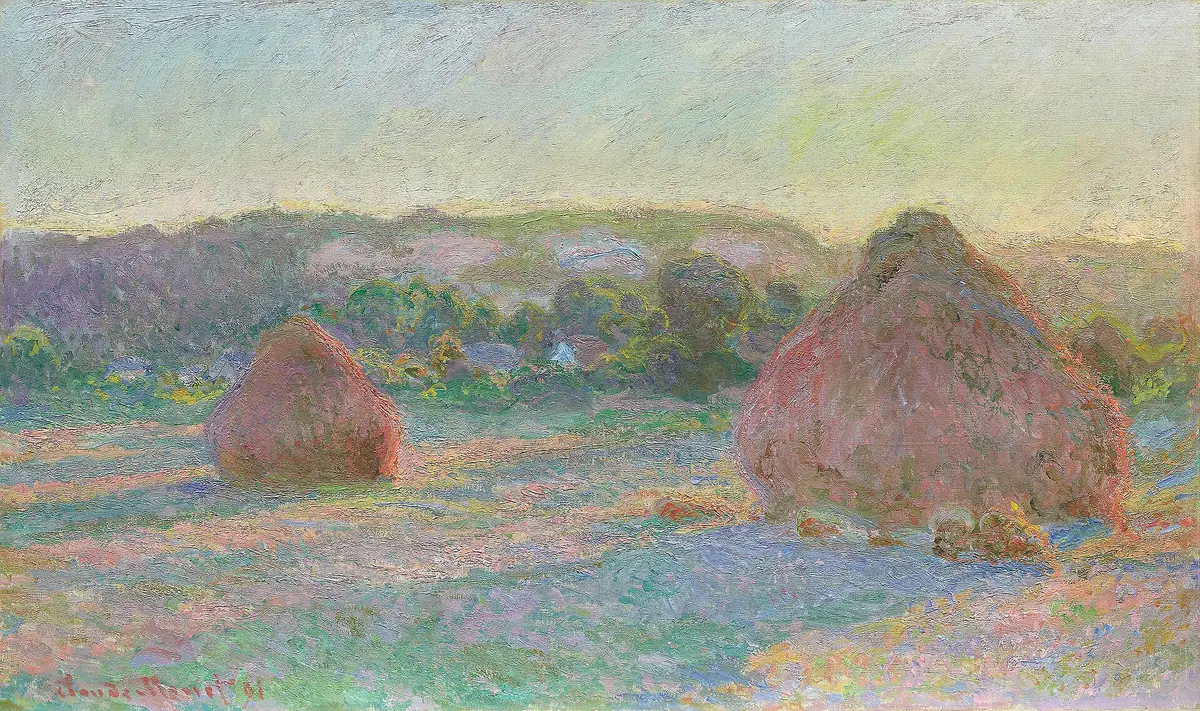

How Many Water Lilies Did Monet Paint? Why Museums Say 250 or 300
Monet painted about 250 Water Lilies, nearly 300 counting the whole pond cycle. What each museum figure counts and where they hang, from the Orangerie to MoMA.

How many Water Lilies did Monet paint? The number you will see most often is about 250. The National Gallery in London says his water garden at Giverny was the subject of some 250 paintings, and the Cleveland Museum of Art says around 250 water lily compositions. The Musée de l'Orangerie in Paris, which shows eight enormous Water Lilies, describes a cycle of almost 300. None of these figures is wrong. Each one counts a different set: pictures of lilies, pictures of the pond, mural-size panels, or the compositions installed on a wall. Once you know which set a source means, the numbers stop contradicting each other.
The short answer: about 250 paintings over nearly three decades
Water Lilies (Nymphéas in French) is not the title of one painting. It is the name of a series Monet painted at his garden in Giverny from the late 1890s until his death in December 1926. Many single canvases in the series carry the same title, which is why a museum label, a poster, and a book can all say "Water Lilies" while pointing at different objects.
The best-supported single answer is about 250, a figure that the National Gallery in London and the Cleveland Museum of Art reach independently. Both are rounded, and museums write them that way on purpose: as the next section shows, the total depends on where you draw the edge of the series.
So there is no one "original" Water Lilies to find. The 1906 canvas in Chicago, the near-square 1916 canvas in Tokyo, and the three-panel work at the Museum of Modern Art in New York are all originals. What separates them is not authenticity but date, size, how much of the garden shows, and the state of the light on the water.
Why museums say 200, 250, or almost 300
| Number | Source | What is counted |
|---|---|---|
| About 200 | National Gallery, London | Paintings that show lilies floating on the surface of the pond |
| Some 250 | National Gallery, London | All paintings of the water garden, including the bridge, willows, wisteria, and irises |
| Around 250 | Cleveland Museum of Art | Water lily compositions |
| Almost 300 | Musée de l'Orangerie | The whole body of paintings that grew out of the pond |
| More than 40 | Musée de l'Orangerie; MoMA | Large-format decorative canvases, which Monet called grandes décorations |
| 125 | Musée Marmottan Monet | Large panels painted between 1914 and 1926 |
| 22 panels, 8 compositions | MoMA; Musée de l'Orangerie | What France received and installed in the Orangerie's two oval rooms |
The National Gallery's own breakdown shows how much depends on definitions. Of the roughly 250 paintings of the water garden, it says around 200 show lilies floating on the water. The rest include the Japanese bridge, willows, wisteria, or irises. Whether a picture of the footbridge "counts" as a Water Lily is a choice the writer makes, not a fact about the painting.
The Orangerie describes the cycle as almost 300 paintings, more than 40 of them large format. That is the broadest count in common use. MoMA's study of the series also gives more than 40 for the big decorative canvases. The Musée Marmottan Monet, which holds the world's largest Monet collection, says Monet painted 125 large panels between 1914 and 1926. The museums do not publish a shared definition of "large," so the gap is best read as two categories rather than a correction: Marmottan's figure probably takes in a wider band of big canvases, including ones never meant to join a mural.
Panels and compositions are another trap. Each of the eight Orangerie works is several canvases joined side by side, and MoMA puts the total at 22 panels. Count the canvases and you get 22. Count the works as they hang and you get eight.
Finally, some paintings no longer exist. Monet destroyed canvases he doubted while working on the late series. MoMA bought a large Water Lilies panel in 1955 and a smaller one in 1956; both were lost after a fire at the museum on April 15, 1958. Any total is approximate, which is why careful sources write "about," "some," or "almost."
The pond in the Water Lilies was built to be painted
Monet rented a house at Giverny, northwest of Paris, in 1883 and bought the property in 1890. In 1893 he bought an extra plot across a road and a railway line and began turning a small pond there into a water garden. The Fondation Claude Monet, which runs the house and gardens today, says he diverted the Ru, a small branch of the river Epte, to feed it.
He stocked the pond with hybrid water lilies and crossed it with a curved, Japanese-style wooden footbridge in 1895. The pond was enlarged again in 1901 and 1904, which the National Gallery says tripled the size of the water garden. By MoMA's account, Monet eventually employed six gardeners to keep the grounds in shape.
Monet was candid about the purpose. The National Gallery records his explanation that he wanted the pond to please the eye and to give him subjects to paint. The scene that looks like untouched nature in the paintings was a designed, planted, and maintained place. The light, the weather, and the seasons were the parts he could not control, and those are what the series keeps returning to.
This also explains why the Water Lilies feel different from Monet's earlier Impressionism. In a painting such as Poppies, he walks into a field near Argenteuil and records a summer afternoon. At Giverny he owned the motif, could step out to it every day, and could watch it change for decades.
From a bridge over a pond to water with no horizon
You do not need to memorize 250 paintings to follow the series. Three broad phases cover the main change. The dates overlap and are a guide for looking, not hard boundaries.
| Period | What the canvas shows | How it reads |
|---|---|---|
| 1895–1900 | The Japanese footbridge, the banks, and the planting | You can tell where you are standing in the garden |
| 1903–1909 | The water surface, the lilies, and reflected sky and trees | Horizon and banks drop away, and up and down start to blur |
| 1914–1926 | Mural-size canvases of lilies, clouds, and willows | Several panels join into one wall of water around the viewer |
The first phase is about the bridge. The National Gallery says Monet painted three views of it in 1895, came back to the subject in 1899, and in December 1900 showed 12 bridge paintings at the Durand-Ruel gallery in Paris. The Met's Bridge over a Pond of Water Lilies (1899) and the National Gallery's The Water-Lily Pond (1899) belong to this group. The arch runs across the canvas, the banks are thick with plants, and you can still picture where the painter stood.
From 1903, according to MoMA, Monet concentrated on pictures that left out the horizon, the sky, and the ground, keeping only the pond's surface and its reflections, sometimes with a hint of the bank. In May 1909 he showed 48 of them at Durand-Ruel. The Art Institute of Chicago's nearly square Water Lilies of 1906 was in that exhibition, listed as "Série 1906." In pictures like this the clouds appear in the water among the lilies, so the sky seems to lie beneath the flowers.
From 1914, at seventy-three, Monet started the mural-size canvases he called grandes décorations. MoMA describes the routine: smaller canvases outdoors in summer, then in winter the studio, with paintings about 6.5 feet tall and up to 20 feet wide (roughly 2 by 6 meters). He worked on several at once, going back and forth between them for years. To make room for them he built a vast studio with a glass ceiling; MoMA dates the start of construction to 1915, and the Orangerie gives 1916.
Why Monet painted the same pond again and again
The pond never looks the same twice. The height of the sun, passing clouds, wind on the surface, the season, flowers opening and closing, and the reflections of sky and trees all change at once. A single canvas can hold only one of those states, so a series was the natural way to deal with a subject that keeps moving.
It was also how Monet had worked for years. MoMA points out that in the 1890s his series of grainstacks, poplars, and Rouen Cathedral sold quickly, and that the repetition made collectors keener, not less interested, to own one. The 1909 Water Lilies show at Durand-Ruel drew crowds and buyers too. Painting in series was an artistic method and a working business model at the same time. For the series that started it, read why Monet painted the same haystacks again and again.
And there was a larger plan from early on. MoMA cites a journalist, Maurice Guillemot, who reported in 1898 that Monet imagined a circular room whose walls would be covered with paintings of water dotted with lilies. Almost thirty years later, that idea became the Orangerie.
One caution: the late Water Lilies are not on-the-spot weather records. MoMA describes canvases reworked over months and years, with thick layers of paint built up in the studio. What you see is accumulated looking, memory, and painterly decisions, not a single moment captured outdoors. If you want to place this late work against the art that came after Impressionism, the comparison of Impressionism and Post-Impressionism gives the wider picture.
The Orangerie's Water Lilies: eight compositions, not eight paintings
On November 12, 1918, the day after the Armistice, Monet wrote to his friend Georges Clemenceau, the prime minister. The Orangerie says he offered two large panels to the nation as a symbol of peace. MoMA adds that Clemenceau persuaded him to enlarge the gift, that the state finally received 22 panels forming eight compositions, and that Monet kept the right to approve the building and the installation plan.
The eight works are all the same height, 1.97 meters (6.5 feet), but different lengths, so they could follow the curved walls of two egg-shaped rooms. Together they run for nearly 100 meters and cover about 200 square meters. Daylight comes in from above, so the paintings change with the weather outside. They were installed in 1927, a few months after Monet's death.
The Orangerie lists the eight by their French titles: Matin (Morning), Les Nuages (The Clouds), Reflets verts (Green Reflections), Soleil couchant (Setting Sun), Reflets d'arbres (Reflections of Trees), Le Matin clair aux saules (Clear Morning with Willows), Le Matin aux saules (Morning with Willows), and Les Deux Saules (The Two Willows).
The rooms were not an instant success. MoMA describes two decades of neglect: little light or heat, water leaking through the skylight, and shrapnel from Allied bombing lodged in the canvases during the Second World War. Things changed after renovations in 1952, when the painter André Masson called the galleries "the Sistine Chapel of Impressionism."
Seeing them in person is not like a modern "immersive" projection. Nothing moves except you and the daylight. You walk along a continuous surface of water that has no frame and no fixed starting point, which is exactly the effect Monet planned.
Where are Monet's Water Lilies today?
The paintings are spread across museums and private collections worldwide, so no single place has them all. The table lists major public examples that are documented on the museums' own pages or in MoMA's study of the series.
| Museum | Work | Note |
|---|---|---|
| Musée de l'Orangerie, Paris | Eight large compositions, 1.97 m high | Installed to Monet's own design |
| Musée Marmottan Monet, Paris | A group of large late Water Lilies | Came with Michel Monet's bequest in 1966 |
| Museum of Modern Art, New York | Water Lilies, 1914–26, a triptych | 200 × 1,276 cm overall |
| Metropolitan Museum of Art, New York | Bridge over a Pond of Water Lilies, 1899 | An early footbridge picture |
| Art Institute of Chicago | Water Lilies, 1906 | Shown in Paris in 1909 as "Série 1906" |
| Cleveland Museum of Art | Water Lilies (Agapanthus), c. 1915–26 | 201.3 × 425.6 cm |
| National Gallery, London | The Water-Lily Pond, 1899, and three later works | Bought in 1927 |
| National Museum of Western Art, Tokyo | Water Lilies, 1916 | A near-square canvas, 200.5 × 201 cm |
Paris has two essential stops. The Orangerie is the only place to see the late decorations as Monet arranged them. The Musée Marmottan Monet calls its holdings the world's biggest collection of Monet's work; when his son Michel died in 1966, more than a hundred Monets, including a group of large-format Water Lilies, came to the museum.
In New York, MoMA bought its first large Water Lilies panel in 1955 and lost it in the 1958 fire. The triptych it shows today, 200 by 1,276 centimeters overall, came after that loss, along with a single panel almost 6 meters wide. The Met has the 1899 bridge picture, and MoMA's study also lists a 1914–26 Water Lilies at the Met, given in 1983.
The National Gallery in London holds The Water-Lily Pond (1899) and three later paintings of the water garden: Water-Lilies, Setting Sun, Irises, and Water-Lilies. In Tokyo, the National Museum of Western Art's 1916 canvas, part of the Matsukata Collection, fills almost two meters in each direction with the pond's surface.
Works rotate, travel, and go into storage, so check a museum's "on view" status before planning a trip around one canvas. If you would rather live with them every day, the Monet wallpaper guide for Mac shows which Monet canvases fit a MacBook screen and why the very wide Agapanthus panel suits an ultrawide display.
Did cataracts change the Water Lilies?
Monet was diagnosed with cataracts in 1912, and MoMA notes that he struggled with failing eyesight for the rest of his life. Some late works, such as MoMA's The Japanese Footbridge of about 1920–22, use maroons, rusts, and oranges found nowhere else in his work. When the late paintings were finally seen, some viewers blamed his eyesight for compositions they found hard to read and colors they found unruly.
That explanation is too simple for the Water Lilies as a whole. The horizonless pictures of the water surface began in 1903, nine years before the diagnosis. The idea of a room surrounded by water dates to 1898, and the mural-size project began in 1914 as a deliberate plan. Eyesight was a condition Monet worked under, not the reason the series looks the way it does.
It also helps to look before reading the medical history. Note the range of color, how hard or soft the edges are, how thick the paint sits, and whether any bank survives at the edge. Then add the date and what is known about his vision. That order keeps the diagnosis from replacing the painting.
Quick answers about Monet's Water Lilies
How many Water Lilies paintings did Monet make?
About 250 is the figure you will see most often. The National Gallery in London says the water garden was the subject of some 250 paintings, of which around 200 show lilies on the water. The Musée de l'Orangerie uses a broader count and describes the cycle as almost 300 paintings.
How many Water Lilies are in the Musée de l'Orangerie?
Eight large compositions, hung in two oval rooms. Each composition is made of several canvases joined side by side, 22 panels in all according to MoMA. They are the same height, 1.97 meters, and run for nearly 100 meters together.
Where is the original Water Lilies painting?
There is no single original. Water Lilies is the name of a series, and each canvas in it is an original. The largest groups are in Paris, at the Musée de l'Orangerie and the Musée Marmottan Monet, and many single works are in museums such as MoMA, the Met, the Art Institute of Chicago, the National Gallery in London, and the National Museum of Western Art in Tokyo.
When did Monet paint the Water Lilies?
From the late 1890s until his death in December 1926. The early pictures show the footbridge and banks, from 1903 he focused on the water surface alone, and from 1914 he worked on the mural-size canvases that became the Orangerie decorations.
How to compare two Water Lilies paintings
Faced with a Water Lilies canvas, most people look for the flowers first. To see how the series changes, look at what survives at the edges of the picture instead.
- Check for the bridge, a bank, or a tree trunk
- Look for a horizon line separating water from sky
- See whether the lilies recede into depth or scatter across the whole surface
- Separate the real plants from reflected clouds and willows
- Step close and count the colors in a single brushstroke
- Step back until the marks turn into water again
- Read the date and size, then compare one feature with another Water Lilies
A 1899 bridge picture tells you where you are. A 1906 surface picture makes up and down uncertain. A late panel makes the pond continue past the edges of your vision. Monet did not paint the same answer 250 times; he painted about 250 different ways the same place could look.
Counting problems like this are common with famous series. Van Gogh's Sunflowers raise the same question on a smaller scale, covered in How many Sunflowers did Van Gogh paint?. For a single Monet looked at closely, read why the shadows are blue in The Magpie.
See a different Monet on your screen each day
Art4 brings public-domain paintings, including Monet's, to your Mac as wallpapers. Browse by artist or movement and compare how one painter's color and composition change from work to work.
Primary sources and collection research
- National Gallery, London: Claude Monet, The Water-Lily Pond (1899)
- Cleveland Museum of Art: Water Lilies (Agapanthus), c. 1915–26
- Musée de l'Orangerie: History of the Water Lilies cycle
- Musée de l'Orangerie: The Water Lilies by Claude Monet
- Museum of Modern Art: Claude Monet, Water Lilies (Ann Temkin and Nora Lawrence)
- Musée Marmottan Monet: The museum and its history
- Metropolitan Museum of Art: Bridge over a Pond of Water Lilies (1899)
- Art Institute of Chicago: Water Lilies (1906)
- National Museum of Western Art, Tokyo: Water Lilies (1916)
- Fondation Claude Monet: Water lily pond
Keep a painting like this on your Mac
Art4 lets you browse public-domain paintings by artist, movement, color, and screen shape, read the story behind each one, and set it as your wallpaper, or let it rotate on its own. Try it free for 7 days; if you keep it, it’s a one-time $14. Requires macOS 14 or later, or Windows 10 or later.