
Why Is the Mona Lisa So Famous? Technique, a King, a 1911 Theft
Why is the Mona Lisa so famous? Leonardo's sfumato and smile, Francis I's purchase, the Louvre, Peruggia's 1911 theft, and whether it is overrated.
The Mona Lisa did not become famous overnight in 1911, and it did not become famous because of a hidden code. Its fame was built in layers. Leonardo painted a portrait that other artists immediately copied. A French king bought it. The Revolution put it in a public museum. Nineteenth-century writers wrapped the smile in mystery. Then a theft made the empty wall front-page news across the world, and a century of reproductions did the rest. Each layer depended on the one before it.
The short answer: the Mona Lisa's fame was built in six layers
| When | What happened | What it added |
|---|---|---|
| 1503 to 1519 | Leonardo keeps reworking the portrait for years | A new kind of portrait: a turning pose, soft transitions, a vast landscape |
| 1504 to 1550 | Raphael borrows from it; Vasari praises it in print | Artists and readers learn that this is a model to study |
| 1518 to 1793 | Francis I acquires it; it passes from the French Crown to the Louvre | A royal treasure becomes public property in a public museum |
| Mid-1800s | Writers such as Walter Pater turn the sitter into an enigma | The idea of a secret behind the smile takes hold |
| 1911 to 1914 | Theft, two years of headlines, recovery in Florence | People who never cared about painting now know the face |
| 1919 onward | Parody, advertising, tours abroad, mass reproduction | The image becomes a symbol that works even when altered |
The popular explanation is that the Mona Lisa was a minor painting until it was stolen. That gets the order wrong. The Louvre's own catalogue entry traces the painting's reputation back to Leonardo's lifetime: artists such as the young Raphael studied it in Florence, more than a hundred copies are known, and Giorgio Vasari's 1550 biography of Leonardo set it among the great works of Italian painting. The museum also notes that the painting was treated as a star as soon as it arrived at the Louvre.
What the 1911 theft changed was the audience. According to the Louvre, it gave the painting a worldwide and, above all, popular celebrity. After its recovery in 1913 it became the museum's principal masterpiece. So there are two honest answers to "why is the Mona Lisa so famous?" Among painters and critics, it was famous for how it was made. Among everyone else, it became famous because of what happened to it.
What is actually on the panel
| Item | Detail |
|---|---|
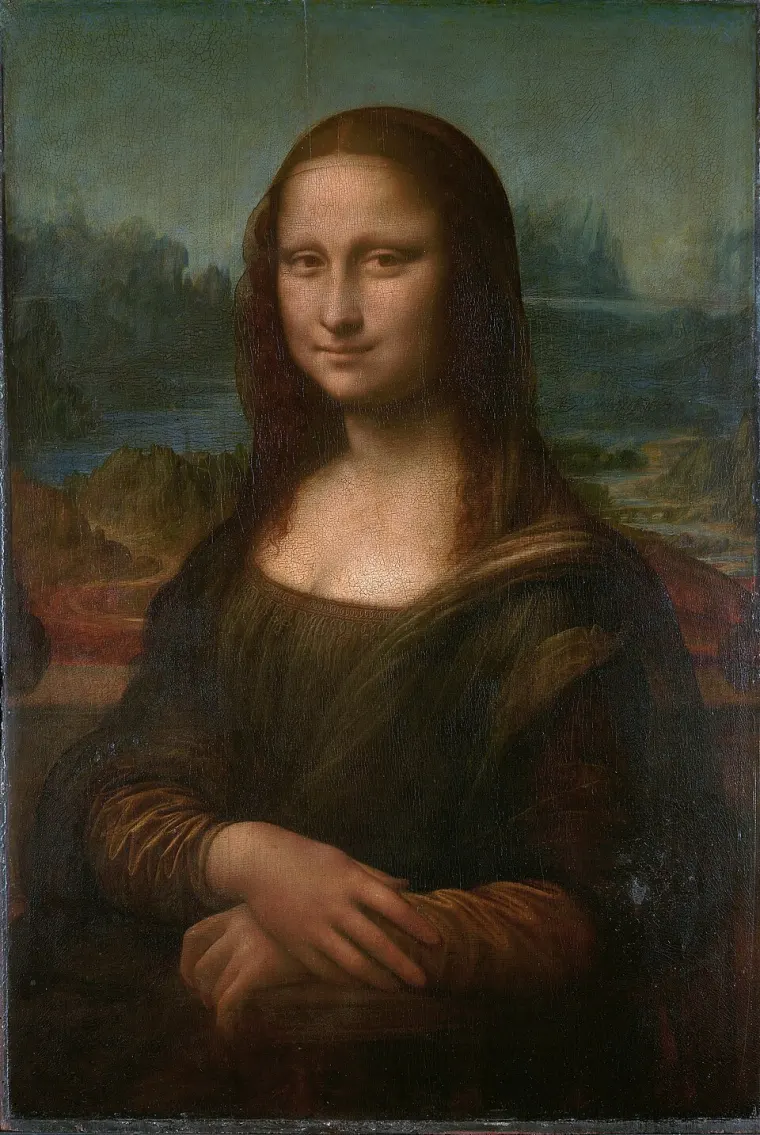
| Title at the Louvre | Portrait of Lisa Gherardini, wife of Francesco del Giocondo, known as the Mona Lisa (La Joconde, La Gioconda) |
| Artist | Leonardo da Vinci (1452–1519) |
| Date | c. 1503–1519; already begun by October 1503 |
| Medium | Oil on a poplar panel |
| Size | 79.4 × 53.4 cm (about 31¼ × 21 in) |
| Inventory number | INV 779 |
| Where to see it | Salle des États (Room 711), Denon wing, level 1, Musée du Louvre, Paris |
The Mona Lisa is painted on wood, not canvas. Leonardo chose a fairly large poplar panel so he could show the sitter at life size. The wood has warped over time, and a crack about 11 centimeters long runs down from the top edge, through the hair, and stops at the level of the forehead. Contrary to a story that still circulates, the panel was never cut down: the Louvre points to its bare edges and to a ridge of paint that formed against the original working frame.
The sitter is Lisa Gherardini, a Florentine woman born in 1479 who married the silk merchant Francesco del Giocondo in 1495. Her married name is why the painting is called La Gioconda in Italian and La Joconde in French. "Mona" is a contraction of "Madonna," a polite form of address. The Louvre calls the alternative identities proposed since the twentieth century a false problem. A margin note written in October 1503 by Agostino Vespucci, a Florentine official who knew Leonardo, compares Leonardo to the ancient painter Apelles, who left a work unfinished, and names the "head of Lisa del Giocondo" as an example. The painting was therefore already under way that autumn. The note was discovered in a book in Heidelberg in 2005.
Look at how she sits. She is not shown in strict profile, the older Italian formula, but in a three-quarter view borrowed from Flemish portraits. Her body turns, her face turns a little further toward us, and her right hand has just come to rest on her left, on the arm of a chair. Behind her is a low parapet, with two small columns only partly visible at the far edges, and beyond it a landscape of mountains, water, a winding road on the left, and a bridge on the right. The Louvre describes the effect as less a window than an open door: she seems to have turned to greet someone arriving.
Sfumato: Leonardo painted the face without hard edges
Sfumato comes from the Italian word for smoke. In practice it means that forms are modeled by transitions from shadow to light so gradual that you cannot point to where one ends and the next begins. According to the Louvre, Leonardo built the face from very thin glazes, oily layers carrying very little pigment, so that contours dissolve instead of being drawn.
Try to find a line in the Mona Lisa's face and you will struggle. The edge of the cheek melts into shadow. The corners of the mouth have no crisp outline. The eyelids are suggested rather than drawn. This is why the face looks soft and alive in a way that a face built from outlines does not. It is also why the expression is unstable, which matters for the next section.
The same softening runs through the background. The distant mountains fade into haze, an effect called atmospheric perspective that makes them read as far away. The Louvre also notes that the painting was never quite finished: a patch of roughly sketched ground at the lower right of the landscape shows where Leonardo stopped.
The museum ranks the Mona Lisa with the Virgin and Child with Saint Anne and Saint John the Baptist, both also in the Louvre, as Leonardo's masterpieces in oil technique. When people say the painting is technically remarkable, this is what they mean: not dazzling detail, but control over transitions that no line drawing could imitate.
Why the smile seems to appear and disappear
Many people notice that the smile looks clearer when they are not looking straight at it. There is a well-known explanation from vision science. The Harvard neurobiologist Margaret Livingstone showed that the smile is more apparent in peripheral vision than in central vision, because peripheral vision is more sensitive to low spatial frequencies, the broad, blurry shapes in an image. The soft shadows at the corners of the mouth are exactly that kind of shape.
You can test it yourself. Look directly at the mouth and the expression tends to settle into something neutral. Look at her eyes, or at the landscape over her shoulder, and the smile seems to return. The painting is not changing. Your eyes are reading it in two different ways, and sfumato leaves room for both readings.
The smile also has a history. The Louvre notes that smiling sitters were rare in portraits of the time, though not unknown; Antonello da Messina had painted them before Leonardo. Leonardo used the same expression in his religious paintings. The museum suggests he used it to make the face graceful and to create an immediate connection with the viewer, hinting at feelings without revealing their cause. It also points out a possible pun: "giocondo" means cheerful in Italian, so La Gioconda is, among other things, the cheerful woman.
From Leonardo's studio to a French king and a public museum
Portraits were normally delivered to the people who paid for them. This one never was. Leonardo kept it and continued to work on it for years, and he took it with him when he moved to France in 1516. In 1999 the historian Bertrand Jestaz found a payment record in the French National Archives: in 1518, King Francis I paid 2,604 livres to Salaì, one of Leonardo's longtime pupils, for several paintings. Given the size of the sum, the Louvre concludes that these were Leonardo's own originals and that the Mona Lisa was very probably acquired by the king that year.
That unusual history matters. A private portrait of a merchant's wife became part of the French royal collection, and it stayed there for almost three centuries. After the Revolution, the royal collections became national property; the Louvre's database gives 1793, the year the museum first opened to the public, as the painting's acquisition date. A painting once seen by courtiers could now be seen by anyone who walked in.
Reputation followed access. Vasari, writing in 1550, praised the eyes, eyebrows, nose, and mouth as if they were living flesh, even though he had never seen the painting himself. In the second half of the nineteenth century, writers went further and turned the sitter into a figure of mystery. Walter Pater's essay on Leonardo, dated 1869 and later collected in The Renaissance, contains the much-quoted line "She is older than the rocks among which she sits." The Louvre treats this kind of writing as the origin of the persistent myth that the picture hides a secret.
The 1911 theft: how an empty wall became world news
On Monday, August 21, 1911, a day when the Louvre was closed to the public, the Mona Lisa was taken off the wall. The thief was Vincenzo Peruggia, an Italian glazier who had worked at the Louvre. The museum's account for young visitors says he had been given the job of making a protective display case for the painting, that he hid in the building after closing time on Sunday, and that the next day he took the panel down and left without being seen. The loss was reported in the newspapers on Tuesday, August 22.
The investigation stalled. The poet Guillaume Apollinaire was arrested and spent several days in prison before being cleared; Pablo Picasso also came under suspicion. Many accounts of the case describe visitors coming to the Louvre just to look at the empty space on the wall. According to the museum, nothing was heard of the painting for more than two years.
In December 1913, Peruggia, now in Florence, offered the painting to the art dealer Alfredo Geri. Geri alerted the authorities, and Peruggia was arrested. The Louvre says he claimed he wanted to return the painting to Italy. Before going back to Paris, the Mona Lisa was put on view in Italy, including at the Uffizi in Florence, the gallery that holds Botticelli's Birth of Venus. On January 4, 1914, it was back in its place at the Louvre.
The theft did not create the painting's artistic reputation, but it changed who knew about it. For more than two years the Mona Lisa was a news story with a missing object, suspects, and a foreign capital involved. People who had never been to a museum read about the face in the papers. When it returned, visitors came to see the painting that had been stolen, and that kind of curiosity has never really left the room.
Copies, parodies, and travel kept the face in circulation
The Mona Lisa is unusually easy to copy and still recognize. It is a single figure with a clear silhouette, a centered face, and folded hands. You can crop it to the head, print it in black and white, or change it entirely, and people still know what it is. Copies were made from the sixteenth century onward; the Louvre counts more than a hundred. One made in Leonardo's own workshop, now in the Prado in Madrid, has been restored, and the Louvre uses it to understand details of the sitter's clothing that are hard to read on the darkened original.
In the twentieth century, that recognizability turned the painting into raw material. In 1919, Marcel Duchamp added a mustache and goatee to a postcard reproduction and titled it L.H.O.O.Q. Advertisers, cartoonists, and filmmakers followed. Every parody depends on the viewer already knowing the original, and every parody makes the original better known.
The painting also traveled, very rarely. The Louvre describes it as France's ambassador to the United States in 1963, when it was shown in Washington and New York, and to Japan and the Soviet Union in 1974. The Tate's account of the 1963 opening at the National Gallery of Art describes a party for 2,000 guests with President Kennedy and the French culture minister André Malraux. Since 1974 the painting has stayed at the Louvre because of its extreme fragility.
The same thing happened to another quiet portrait of a young woman. Vermeer's Girl with a Pearl Earring is often called the Mona Lisa of the North, a nickname that tells you how far the Mona Lisa's fame has become a unit of measurement for other paintings.
Is the Mona Lisa overrated?
It depends on what you are rating. If you mean the experience of seeing it at the Louvre, it can be disappointing, and the reasons are concrete. Since 1966 the painting has hung in the Salle des États, the largest room in the palace, and since 2005 it has been displayed in the middle of the room in a protective, temperature- and humidity-controlled glass case. Opposite it hangs Veronese's Wedding Feast at Cana, which at almost 70 square meters is the biggest painting in the Louvre. A life-size half-length portrait, seen from behind a barrier and a crowd in a room that size, will look small. The Louvre reported 8.7 million visitors in 2024, and its own visitor trail describes people queuing for a personal glimpse of the Mona Lisa.
The glass is there for good reasons. The Louvre's catalogue records that in 1956 a man threw a stone at the painting, breaking the protective glass and slightly damaging the left elbow. The case also keeps the fragile poplar panel in a stable environment.
The colors are another source of disappointment. According to the Louvre, the painting is covered by many thick, uneven layers of varnish applied after Leonardo's death. They have oxidized into a yellow filter that shifts the whole palette, turning the blue sky greenish and darkening the lower part of the composition. What you see is not quite what Leonardo painted, a problem shared by other old masterpieces such as Rembrandt's Night Watch.
If you mean the painting itself, the case for it is strong and specific. The turning pose, the hands resting naturally rather than propped on a ledge, the dissolving contours, and the landscape that fades into distance were new in combination, and painters copied them while Leonardo was still alive. Its fame is out of proportion to any single painting, but the painting is not a fraud that fame invented.
The viewing conditions may change. The Louvre's long-term redevelopment plan, Louvre Nouvelle Renaissance, includes a space designed specifically for the Mona Lisa, where visitors can see it in more comfortable conditions. The architects were chosen in 2026; the Louvre's page does not yet give an opening date.
How to look at the Mona Lisa, in the room or on a screen
- Start with the hands. Notice that the right hand lies over the left, resting on the arm of the chair, and look at the thin veil over the sleeve
- Compare the direction of the body with the direction of the face. The body turns, and the head turns a little further
- Find the two column bases at the far left and right edges, just above the parapet
- Follow the winding road on the left and the bridge on the right into the distance
- Look at her eyes for a few seconds, then let your attention slide to the mouth and notice when the smile is strongest
- Imagine the sky blue instead of greenish, and remember that the varnish, not Leonardo, set today's color
If you go to the Louvre, give yourself a minute away from the front of the crowd. The painting is designed to be read from a moderate distance, and sfumato does its work best when you are not pressed up against it. On a screen, a high-resolution image lets you do what the room does not: zoom in slowly on the transitions at the corners of the mouth, then zoom out until the face becomes whole again.
It also helps to set the reputation aside and look the way you would at an unfamiliar portrait. The Mona Lisa is a picture of a particular woman, made by a painter who would not let it go. Once you see the turning body and the soft shadows, the fame becomes the least interesting thing about it.
See a familiar face again, one day at a time
Art4 brings public-domain masterpieces to your Mac as wallpapers, with curated guides by artist, movement, and theme so you can look again at paintings you thought you knew.
Primary sources and further reading
- Louvre collections database: Mona Lisa, INV 779 (catalogue commentary by Vincent Delieuvin, in French)
- Louvre: From the Mona Lisa to The Wedding Feast at Cana
- Louvre: A superstar… and a wedding crowd!
- Louvre Kids: The Theft of the Mona Lisa, video transcript (PDF)
- MIT McGovern Institute: Margaret Livingstone awarded the 2024 Scolnick Prize
- Walter Pater, The Renaissance: Studies in Art and Poetry (Project Gutenberg)
- Tate Etc.: Jackie, JFK and the art of diplomacy
- Louvre: Louvre Nouvelle Renaissance international architecture competition
- Louvre press office: 8.7 million visitors to the Louvre in 2024
Keep a painting like this on your Mac
Art4 lets you browse public-domain paintings by artist, movement, color, and screen shape, read the story behind each one, and set it as your wallpaper, or let it rotate on its own. Try it free for 7 days; if you keep it, it’s a one-time $14. Requires macOS 14 or later, or Windows 10 or later.