
The Great Wave off Kanagawa Explained: Fuji and Hokusai's Blue
What does The Great Wave off Kanagawa mean? Find Mount Fuji and the three boats, see how The Met explains Hokusai's Prussian blue, and learn why prints differ.
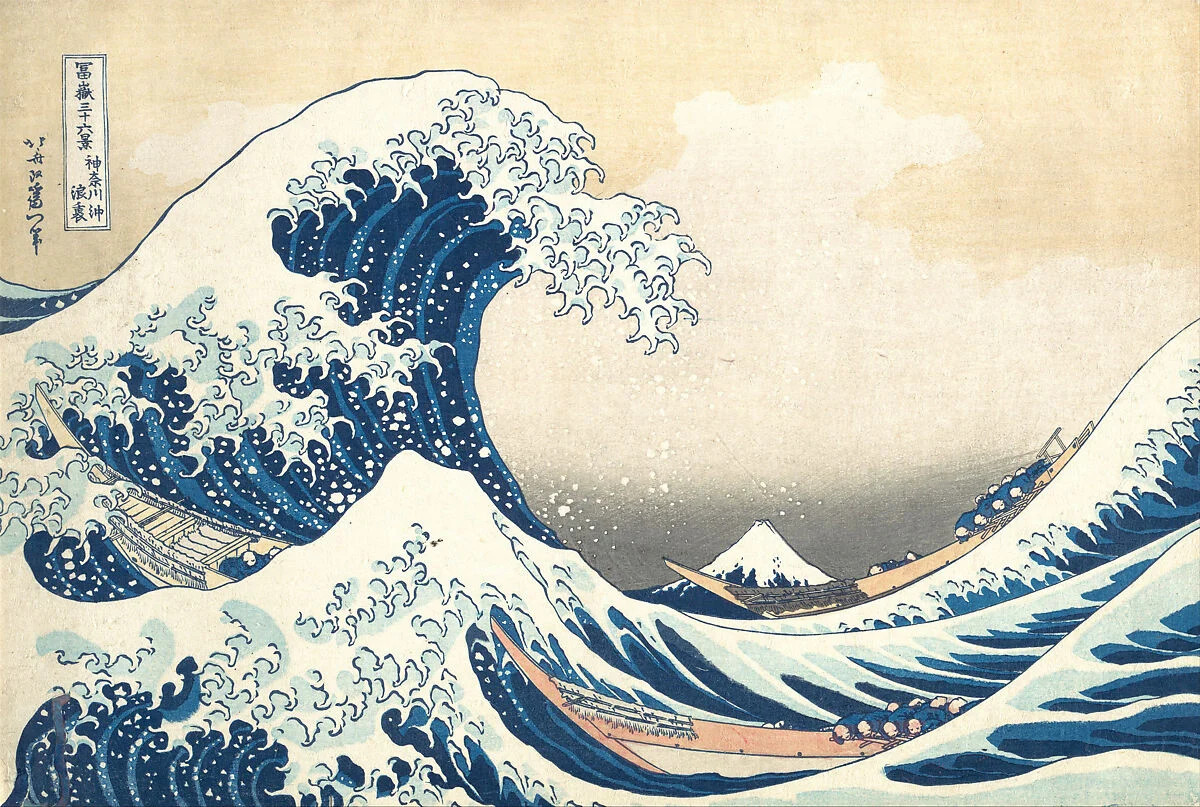
Most people can draw the outline of The Great Wave from memory, and many of them have never noticed the boats. There are three, long and narrow, packed with men who have pulled their heads down below the gunwales. Find them first, and the famous blue pattern turns into a sea that is about to come down on top of people. Then look for the small white mountain in the middle. Hokusai's print is a picture of Mount Fuji as much as a picture of a wave, and the relationship between the two is where its meaning lives.
What the title means, and what the scene shows
| Item | Detail |
|---|---|
| Title | Under the Wave off Kanagawa (Kanagawa oki nami ura), also known as The Great Wave |
| Series | Thirty-six Views of Mount Fuji (Fugaku sanjūrokkei) |
| Artist | Katsushika Hokusai (1760–1849) |
| Date | c. 1830–32 (The Met's dating for its impression) |
| Medium | Woodblock print; ink and color on paper |
| Size | 25.7 × 37.9 cm (10 1/8 × 14 15/16 in) |
| Impression shown here | The Metropolitan Museum of Art, New York, JP1847, H. O. Havemeyer Collection |
"The Great Wave" is a nickname. The print's own title, written in the rectangular cartouche at the upper left, is Kanagawa oki nami ura. The Met translates it as Under the Wave off Kanagawa. "Oki" means the open water offshore, "nami" means wave, and "ura" means the underside or the back of something. The title places you beneath a wave out at sea, off Kanagawa, a post town on the Tokaido highway beside the bay of Edo, the city now called Tokyo.
The more important clue is the series title written beside it: Thirty-six Views of Mount Fuji. Every print in the set shows Fuji from a different place, season, or angle. Read with that in mind, The Great Wave is not a seascape with a mountain in the background. It is a view of Fuji in which the sea happens to fill almost the whole sheet.
The Art Institute of Chicago notes that Hokusai began the series in 1830, when he was 70. The Met dates its impression to about 1830–32; the British Museum dates its own to 1831. Hokusai was not a young innovator here. He was a well-established artist late in a long career, and the Art Institute credits this series with establishing the popularity of landscape prints.
The scene is often called a tsunami, but nothing in the title or the image points to an earthquake or a specific disaster. Museums describe it simply as a great, cresting wave. It is safest to read it as a huge breaking sea, not as a record of a historical event.
Where is Mount Fuji in The Great Wave?
Fuji sits just right of center, low in the picture, framed by the hollow of the big wave. It is a small triangle of blue with a white cap of snow, and it is easy to mistake for another wave. Look closely and you will see spray from the crest falling just above the summit, so that snow and foam almost touch.
Now look at the smaller wave in the left foreground, the one rising in front of the big one. Its white peak has nearly the same shape as Fuji. Because it is close to us and the mountain is far away, the wave is much larger on the paper. Hokusai set up two similar peaks at two distances and let the eye move between them. The Met's catalog text puts it plainly: he played with perspective to make the country's grandest mountain look like a small mound inside the hollow of a cresting wave.
The sky around Fuji is almost empty. If Hokusai had filled it with clouds, spray, or more boats, the tiny triangle would disappear. Making the wave enormous and leaving space around the mountain work together. One pushes Fuji into the distance; the other makes sure you still find it.
There is an easy contrast to draw from this: the moving sea against the still mountain, the moment against something permanent. That reading is reasonable, but it is an interpretation, not something Hokusai wrote down. It is more useful to compare the foreground peak and the summit for yourself and feel the distance between them.
Who is in the boats under the Great Wave?
There are three boats. One is on the left, almost swallowed by the trough beneath the big wave. One is in the center, crossing in front of the base of Fuji as it rides up the slope of a wave on the right. The third lies low in the foreground, angled along the slope of a wave. Each is long and narrow, and each is curved like the water around it, which is why they are easy to miss.
The National Gallery of Victoria identifies them as oshiokuribune, fast boats that carried fresh fish and dried sardines in the morning from villages on the Boso Peninsula to the fish markets of Edo Bay. The men are working crews, not passengers on a pleasure trip. Their round heads appear in rows along the gunwales, bent low. Faces are too small to read, but the posture says enough: everyone is holding on.
The people also act as a scale. Once you register that each boat holds a crew of adults, the wave above them stops looking like a decorative curl and becomes taller than any building they could have known. Notice too that there is no shore anywhere in the picture. There is nowhere for a viewer to stand except, in effect, at water level among the boats, looking up.
A moment without an ending
Hokusai does not show what happens next. The crest is curling over, the foam at its edge has broken into small hooked fingers, and the boats are below it. Whether they ride through, as fishing crews did every day, or are overwhelmed is left open.
The tension comes from two things happening at once. The outline of the big wave is clean and continuous, a single sweeping curve from the lower left to the crest. The foam at the top is the opposite: dozens of separate claw-like tips and loose white dots of spray, some of them drifting down toward Fuji. One part of the image is held still, and another is coming apart. The eye cannot settle on either, so the moment feels as if it is still in progress.
Try covering the boats with your thumb. The print becomes a magnificent pattern of blue and white. Uncover them and it becomes a situation with people in it. That shift is one reason the image has lasted. It works as design and as drama, and you can choose which one you are looking at.
Hokusai's blue: Prussian blue and indigo, printed in layers
| Area | Colorant | How it was printed |
|---|---|---|
| Dark stripes inside the wave | A mixture of Prussian blue and indigo | Printed first, giving a deep gunmetal blue |
| Hollow of the wave | Pure Prussian blue | Printed over the stripes, so the darkest areas carry two layers |
| White foam and crest | Unprinted paper | The paper itself, left blank by the carver |
The blue is the first thing most people remember, and it was new. Prussian blue is a synthetic pigment first made in Europe in the early eighteenth century. The Met's research essay notes that when the publisher Eijudo advertised Thirty-six Views of Mount Fuji in time for the New Year of 1831, the series featured this exotic pigment, newly available to the print market. The British Museum describes it as a strong color that did not fade, and the Art Institute of Chicago calls the series' use of it copious: it fills both sky and water in many of the designs.
Look at the inside of the big wave and you will see that the blue is not one flat color. There are dark bands running up the wave, and a brighter blue between and around them. Scientists at The Met analyzed their impression and found that the printers did not simply replace traditional indigo with Prussian blue. They first printed the dark stripes with a mixture of the two, which gives a deep gunmetal tone. Then they printed the hollow of the wave with pure Prussian blue, laying it over the stripes. The darkest areas therefore carry two layers of color.
The result is depth without shading. Follow a dark band from the bottom of the wave upward and it leads you to the white crest, tracing the direction in which the water is rising. The color does the work that modeling with light and shadow would do in a European painting.
The Great Wave is a print: who actually made it
It is easy to talk about "Hokusai's blue," but a woodblock print was a team effort. Hokusai made the design. Carvers cut it into wooden blocks, one for the outlines and others for each color area, and printers inked the blocks and pressed sheets of paper onto them by hand. The Met's essay points out that Hokusai was only one of the artists involved in making the print, but the only one whose name we know.
The printing process left a physical record. When paper is pressed onto a carved block, the raised parts of the block push into it. The Met's scans of its impression found that the paper surface sits at different heights: the white, unprinted paper stands highest, the medium blue printed once sits lower, and the deep blue printed twice sits lowest. The foam, the bright water, and the dark stripes are literally on different levels of the sheet.
A screen cannot show this. A photograph turns the print into a flat image, and a reproduction at poster size changes its scale entirely. The real sheet is about 26 by 38 centimeters, or roughly 10 by 15 inches. It was a commercial print made to be held in the hands, not a mural. If you ever see one in a museum, look at it from an angle and at close range as well as head on.
Is there an original Great Wave?
There is no single original. Because it is a woodblock print, the design was printed many times from the same set of blocks. The British Museum states that several thousand impressions were taken from the cherry-wood blocks. Museums around the world own separate sheets, and each one is an original impression, not a copy.
They are not all equal. Early impressions, pulled while the blocks were fresh, have sharper lines. The British Museum describes its own sheet as a fine early impression, still with sharp outlines. The Met believes its impression was probably one of the earliest printed. The Art Institute of Chicago, by contrast, notes that its three impressions are all later than the first state of the design. As blocks wore down with use, lines could soften or break, and colors could be applied differently from one printing session to the next.
This is why images of The Great Wave online look so different: one has a pale sky, another a yellowish one, another a much deeper blue. Some of that comes from photography and screens, but much of it is real. Different impressions, different printings, and two centuries of light, handling, and storage all leave their mark. A different color does not mean a fake.
When you compare images, start by checking which museum owns the sheet and its accession number. The image on this page is The Met's JP1847. Then compare specific places: the fine lines of the crest, the sky around Fuji, and the outlines of the boats. If you are collecting high-resolution images, the guide to free museum images and open access explains how to start from a collection record rather than an anonymous repost.
The series itself also grew. It was popular enough that the publisher added ten more designs, printed with black outlines instead of blue, so Thirty-six Views of Mount Fuji actually contains forty-six prints.
How the wave traveled beyond Japan
Because it was printed in quantity and was cheap to buy, The Great Wave could travel in a way a painting could not. Japanese prints reached Europe in large numbers in the second half of the nineteenth century, and French artists looked at them closely. When The Met published a 1974 study by Colta Ives on how Japanese woodcuts, including Hokusai's and Hiroshige's, shaped French printmaking by artists such as Manet, Degas, Cassatt, Toulouse-Lautrec, and Gauguin, it titled the book The Great Wave.
That list crosses the line between two movements. Degas and Cassatt exhibited with the Impressionists; Gauguin, who also showed with them in the early 1880s, and Toulouse-Lautrec are usually grouped with the Post-Impressionists. If the distinction is unclear, the guide to Impressionism versus Post-Impressionism sets it out. The flat color areas, strong outlines, and unusual viewpoints of Japanese prints mattered to both.
The Met's catalog text adds that the composition is said to have inspired Claude Debussy's orchestral work La Mer and Rainer Maria Rilke's poem Der Berg. Those connections are part of the print's reception in Europe, not something Hokusai planned. They show how a commercial landscape print made for buyers in Edo became, in other countries, a shorthand for Japan and for the sea.
A way of looking: follow only the white shapes
Once you know the facts, try one more pass in which you ignore the blue completely and follow only the white.
- Start at the claw-like foam at the top of the big wave
- Drop to the white peak of the foreground wave on the left
- Move to the snowcap of Mount Fuji in the center
- Find the scattered white dots of spray falling between the crest and the mountain
- Return to the boats and look for the thin pale lines of their hulls between the waves
White shapes far apart on the sheet echo each other: the crest, the foreground peak, the snow. Seeing those echoes is the same skill as looking at abstract art, where relationships between shapes carry the meaning. The seven-minute method for looking at abstract art practices exactly that.
The order you choose changes the picture. Start with the wave and Fuji feels far away. Start with Fuji and the wave seems to arrive from outside the frame. Start with the boats and the whole image becomes about the people in them.
The MacBook wallpaper resolution guide explains how screen proportions affect crops like this one.
Find the boats again, every time the wave comes back
Art4 brings public-domain masterpieces, from Hokusai to the Impressionists, to your Mac as wallpapers, with curated guides that help you notice what you missed the first time.
Collection records and research sources
- The Met: Under the Wave off Kanagawa (The Great Wave), JP1847
- Marco Leona, The Met: The Great Wave: Anatomy of an Icon
- British Museum: Hokusai's The Great Wave (on Google Arts & Culture)
- Art Institute of Chicago: Under the Wave off Kanagawa, 1925.3245
- National Gallery of Victoria: The great wave off Kanagawa
- Colta Ives, The Great Wave: The Influence of Japanese Woodcuts on French Prints (The Met, 1974)
Keep a painting like this on your Mac
Art4 lets you browse public-domain paintings by artist, movement, color, and screen shape, read the story behind each one, and set it as your wallpaper, or let it rotate on its own. Try it free for 7 days; if you keep it, it’s a one-time $14. Requires macOS 14 or later, or Windows 10 or later.